Last week we learned from the Philly Fed Index that manufacturing activity had slowed in the Third District, which includes most of Pennsylvania, southern New Jersey, and all of Delaware. Today, we got similarly disappointing news from the Federal Reserve Bank of Richmond. This report covers the Fifth District, which includes Maryland, Washington D.C., the Carolinas, Virginia, and most of West Virginia.
Once again, the evidence shows a slowdown in business activity. The composite index fell from +4 in May to -3 in June. It was +14 in April. There was significant deterioration in key individual components of the index as well. Shipments were down and backlog fell. The volume of new orders plummeted, as did capacity utilization and the average workweek. There was an increase in inventories. Input prices and prices for finished goods increased, but at lower rates than in May and April. Perhaps because conditions worsened,manufacturers expect (or hope) that future conditions will improve.
Today's report from the Richmond Fed adds to the evidence that the economy is worsening. Whether the slowdown has anything to do with the crisis in Europe is not entirely clear. Whatever the reason, it is apparent that there is a lack of confidence in how governments worldwide are addressing today's serious economic problems. Furthermore, InvestmentNews reports that 70% of the 450 financial advisers surveyed by Brinker Capital claim that their single biggest fear is another four-year term for the Obama administration. Financial advisers tend to cater to the affluent so this finding may not be surprising. Nonetheless, it does not bode well for an administration that needs the affluent to help finance its reelection campaign.
Tuesday, June 26, 2012
Thursday, June 21, 2012
Philly Fed Fuels Fears of Slowdown
The Business Outlook Survey, better known as the Philly Fed Index, came out this morning and the results were not good. The data comes from a survey of approximately 160 manufacturing companies in the Third Federal Reserve District, which includes most of Pennsylvania, the southern half of New Jersey, and all of Delaware. About half the surveyed firms respond.
The diffusion index plummeted to -16.6 in June from -5.8 in May, the second negative monthly reading in a row. A negative number indicates contraction in the manufacturing sector. A more negative number indicates an increase in the rate of contraction. In other words, business conditions were not good in May and they got worse in June.
The results also indicate that new orders and shipments fell from May to June as did unfilled orders, delivery times, and inventories. While the last three items might appear encouraging, they are not. They indicate a lack of business that could eventually result in layoffs. Ironically, the survey indicated that the number of workers actually increased from May to June; however, the average number of hours worked fell. Unless business activity picks up soon, many firms will conclude they are overstaffed.
The survey also has implications for inflation, or more correctly, the lack thereof. Both input prices and prices received for finished goods fell, which should give the Federal Open Market Committee more confidence in its accommodative monetary policy.
Keep in mind that business executives tend to be optimistic by nature. Indeed, the respondents said they expect business conditions to improve over the next six months. More importantly, however, they were less optimistic than they were earlier this year.
Although these results cover only a small part of country on a geographic basis, the Third District is densely populated and includes a large number of businesses. In other words, the implications for the entire economy are not good. The results are consistent with other data that indicate a general slowdown in economic activity. GDP forecasts of 1.0% to 2.0% growth are beginning to look too optimistic.
The diffusion index plummeted to -16.6 in June from -5.8 in May, the second negative monthly reading in a row. A negative number indicates contraction in the manufacturing sector. A more negative number indicates an increase in the rate of contraction. In other words, business conditions were not good in May and they got worse in June.
The results also indicate that new orders and shipments fell from May to June as did unfilled orders, delivery times, and inventories. While the last three items might appear encouraging, they are not. They indicate a lack of business that could eventually result in layoffs. Ironically, the survey indicated that the number of workers actually increased from May to June; however, the average number of hours worked fell. Unless business activity picks up soon, many firms will conclude they are overstaffed.
The survey also has implications for inflation, or more correctly, the lack thereof. Both input prices and prices received for finished goods fell, which should give the Federal Open Market Committee more confidence in its accommodative monetary policy.
Keep in mind that business executives tend to be optimistic by nature. Indeed, the respondents said they expect business conditions to improve over the next six months. More importantly, however, they were less optimistic than they were earlier this year.
Although these results cover only a small part of country on a geographic basis, the Third District is densely populated and includes a large number of businesses. In other words, the implications for the entire economy are not good. The results are consistent with other data that indicate a general slowdown in economic activity. GDP forecasts of 1.0% to 2.0% growth are beginning to look too optimistic.

Monday, June 18, 2012
The Fed is Like a Drug Dealer
Investors worldwide were holding their collective breath over the weekend worried about the elections in Greece, Egypt, and France. Greece, of course, was the primary focus. Many investors feared that the left-wing Syriza party would win the election and hasten the country's exit from the euro. However, Syriza lost to New Democracy, a more conservative party that has vowed to stick with the nation's previously made bailout agreements. However, New Democracy's victory was not decisive. As a result, it is trying to form a coalition with the third-place finisher.
Initially, markets were relieved. U.S. futures surged, indicating a strong open. But the gains fizzled out as investors began to realize that the election solves nothing. Greece is still in trouble. There is still a good chance it will abandon the euro, only later rather than sooner. Furthermore, Spain and Italy present even more serious problems.
The big mystery is not why the markets opened flat, but why they are holding up so well. The explanation has to do with the Federal Reserve. Investors seem to think that bad news is really good news, and that really bad news is even better. They reason that the worse things get in Europe, the more likely the Fed will come to the rescue by dishing up more stimulus. One concern I've had for a long time is that stock market rallies are being fueled not by improvements in the economy, but by Federal Reserve stimulus. The Fed, however, is like a drug dealer delivering a temporary fix. The Fed cannot address the real problems in the economy. That will require Congressional action. For example, a complete overhaul of the tax code would help matters tremendously. Congress could start by simplifying the tax code. It should eliminate deductions and reduce tax rates. But with an election just months away, it's a sure bet that Congress won't do anything.
We'll hear more from the Fed on Wednesday. Some investors are betting that Ben Bernanke will extend "Operation Twist," the Fed's attempt to bring down long-term interest rates. Unfortunately, the economy's troubles have nothing to do with high interest rates. Nonetheless, the markets may rally in reaction to whatever action the Fed announces. Stock market rallies are nice, but they won't solve the real systemic problems in the economy.
Initially, markets were relieved. U.S. futures surged, indicating a strong open. But the gains fizzled out as investors began to realize that the election solves nothing. Greece is still in trouble. There is still a good chance it will abandon the euro, only later rather than sooner. Furthermore, Spain and Italy present even more serious problems.
The big mystery is not why the markets opened flat, but why they are holding up so well. The explanation has to do with the Federal Reserve. Investors seem to think that bad news is really good news, and that really bad news is even better. They reason that the worse things get in Europe, the more likely the Fed will come to the rescue by dishing up more stimulus. One concern I've had for a long time is that stock market rallies are being fueled not by improvements in the economy, but by Federal Reserve stimulus. The Fed, however, is like a drug dealer delivering a temporary fix. The Fed cannot address the real problems in the economy. That will require Congressional action. For example, a complete overhaul of the tax code would help matters tremendously. Congress could start by simplifying the tax code. It should eliminate deductions and reduce tax rates. But with an election just months away, it's a sure bet that Congress won't do anything.
We'll hear more from the Fed on Wednesday. Some investors are betting that Ben Bernanke will extend "Operation Twist," the Fed's attempt to bring down long-term interest rates. Unfortunately, the economy's troubles have nothing to do with high interest rates. Nonetheless, the markets may rally in reaction to whatever action the Fed announces. Stock market rallies are nice, but they won't solve the real systemic problems in the economy.
Wednesday, March 21, 2012
Is Apple a Buy?
Apple Inc. (AAPL) is the most talked about stock in the market today. It recently broke above $600 per share and it is setting new highs almost on a daily basis. In response, analysts are outdoing one another by raising their price targets. They argue that at just 17 times trailing earnings, and 14 times expected 2012 earnings, AAPL is still a cheap stock. Indeed, AAPL does offer more value than many other highfliers. For example, Lululemon Athletica (LULU), an apparel maker, generates just a fraction of the sales that AAPL produces, yet LULU is selling for 65 times trailing earnings and 60 times expected earnings. So what gives?
One reason why AAPL looks comparatively cheap is because it is so huge. With a market cap of $565 billion, it is the largest stock in the S&P 500 Index by far. In fact, it is 35% larger than the second-largest stock (Exxon Mobil). Investors simply cannot get their minds around a company this big being able to generate the kind of growth typically seem only in small-cap companies. APPL's revenues were up 14% in 2009 then they surged 52% in 2010 and 66% in 2011. Over the past four quarters, sales are up 68%. In other words, despite the company's already gigantic size, revenue growth is still accelerating. One could reasonably argue that there is still plenty of room for growth, especially in international markets. Imagine, for example, how much larger AAPL could get once it establishes a real foothold in China.
Another problem has to with skepticism about the company's ability to continue coming out with revolutionary must-have products--especially now that its co-founder and inspiration, Steve Jobs, has passed away. The stereotypical AAPL customer is young and extremely passionate about the company's products. I personally know a few who live in my house. They refuse to consider buying any competing products. These kinds of customers don't really care if iPhones drop calls or iPads overheat. If APPL builds something, these consumers will run, not walk, to the nearest store. But how long can AAPL count on this lemming-like behavior? How long will customers leap every time the company announces a new product? AAPL depends heavily on exactly the kinds of customers who are also the most fickle. Do something that really upsets them and they will abandon you in a second. And you can bet that the competition is not sitting still. They haven't had much success so far, but competitors are doing their best to try to beat AAPL at its game. Indeed, the next hot gadget may come from a company we haven't even heard of yet.
So is AAPL a buy? I have been around long enough to know that momentum can take any stock much higher--or much lower--than you could possibly imagine. Right now, upside momentum is clearly on AAPL's side. Take a look at the price chart and you will see that for three straight years, AAPL shares increased at a fairly steady rate. However, starting about three months ago, the gains suddenly accelerated. It's a bit like watching Usain Bolt running at full speed unexpectedly shifting into a faster gear. Therefore, I would not be surprised to see this stock go higher, but that's not a bet I'm willing to make. I simply find it impossible to believe that the world's largest company can maintain annual revenue growth rates of 65% for much longer.
Tweet
One reason why AAPL looks comparatively cheap is because it is so huge. With a market cap of $565 billion, it is the largest stock in the S&P 500 Index by far. In fact, it is 35% larger than the second-largest stock (Exxon Mobil). Investors simply cannot get their minds around a company this big being able to generate the kind of growth typically seem only in small-cap companies. APPL's revenues were up 14% in 2009 then they surged 52% in 2010 and 66% in 2011. Over the past four quarters, sales are up 68%. In other words, despite the company's already gigantic size, revenue growth is still accelerating. One could reasonably argue that there is still plenty of room for growth, especially in international markets. Imagine, for example, how much larger AAPL could get once it establishes a real foothold in China.
Another problem has to with skepticism about the company's ability to continue coming out with revolutionary must-have products--especially now that its co-founder and inspiration, Steve Jobs, has passed away. The stereotypical AAPL customer is young and extremely passionate about the company's products. I personally know a few who live in my house. They refuse to consider buying any competing products. These kinds of customers don't really care if iPhones drop calls or iPads overheat. If APPL builds something, these consumers will run, not walk, to the nearest store. But how long can AAPL count on this lemming-like behavior? How long will customers leap every time the company announces a new product? AAPL depends heavily on exactly the kinds of customers who are also the most fickle. Do something that really upsets them and they will abandon you in a second. And you can bet that the competition is not sitting still. They haven't had much success so far, but competitors are doing their best to try to beat AAPL at its game. Indeed, the next hot gadget may come from a company we haven't even heard of yet.
So is AAPL a buy? I have been around long enough to know that momentum can take any stock much higher--or much lower--than you could possibly imagine. Right now, upside momentum is clearly on AAPL's side. Take a look at the price chart and you will see that for three straight years, AAPL shares increased at a fairly steady rate. However, starting about three months ago, the gains suddenly accelerated. It's a bit like watching Usain Bolt running at full speed unexpectedly shifting into a faster gear. Therefore, I would not be surprised to see this stock go higher, but that's not a bet I'm willing to make. I simply find it impossible to believe that the world's largest company can maintain annual revenue growth rates of 65% for much longer.
Tweet
Friday, March 16, 2012
Apple Stands Falsely Accused
"In the theater, our job is to create fictions that reveal truth—that's what a storyteller does, that's what a dramatist does." You can be excused if you mistake this for a quote from George Orwell's 1984. Unfortunately, it is a real statement released by the Public Theater in New York City to defend the lies behind Mike Daisey's accusations against Apple Inc.'s working conditions in China.
Daisey is a performer who put together a fictional piece about Steve Jobs. However, he somehow convinced a prominent member of the media that his story was really true. Ira Glass, a highly respected journalist who hosts the radio show This American Life, devoted an entire episode to Daisey and his lies against Apple. This American Life is distributed by Public Radio International and airs on National Public Radio affiliate stations.
Daisey made up lies about the Foxconn factory in Shenzhen, China. For example, he said he met workers who were just 12-years old, and he said he met workers who were exposed to chemicals that were so toxic, it left their hands shaking "uncontrollably." Apple took a lot of heat for what was supposedly going on at this factory. Now we know they were lies.
The unfortunate truth is that Foxconn has a history of treating workers badly. Indeed, a number of Foxconn employees have committed suicide. As a result, it is not difficult to understand how someone (even a respected journalist) could be duped into believing the worst. Furthermore, because NPR has long been accused of having a liberal, anti-business bias, it is easy to imagine the folks putting together the show champing at the bit. They no doubt knew this story would be big. It turned out to be one of the most popular episodes in the program's history.
But journalists are supposed to be skeptical, and they are supposed to check out the facts. Thanks to Rob Schmitz who works for another show that airs on NPR, Marketplace, we now know the truth. To Mr. Glass's credit, he and Public Radio International have retracted the story. That's more than what some others may have done. Better late than never, yet the damage is already done.
As for Mr. Daisey, he remains defiant. He thinks his only sin was not making it clear to Mr. Glass that he was putting on an act. But he has been selling his fiction as truth to other media outlets as well. Unfortunately, Daisey has victimized the very workers he claims to be protecting. Employee abuse is a real problem in China, but due to Daisey's lies, the next person who comes along with a real story about worker abuse will get a much less receptive hearing.
Tweet
Daisey is a performer who put together a fictional piece about Steve Jobs. However, he somehow convinced a prominent member of the media that his story was really true. Ira Glass, a highly respected journalist who hosts the radio show This American Life, devoted an entire episode to Daisey and his lies against Apple. This American Life is distributed by Public Radio International and airs on National Public Radio affiliate stations.
Daisey made up lies about the Foxconn factory in Shenzhen, China. For example, he said he met workers who were just 12-years old, and he said he met workers who were exposed to chemicals that were so toxic, it left their hands shaking "uncontrollably." Apple took a lot of heat for what was supposedly going on at this factory. Now we know they were lies.
The unfortunate truth is that Foxconn has a history of treating workers badly. Indeed, a number of Foxconn employees have committed suicide. As a result, it is not difficult to understand how someone (even a respected journalist) could be duped into believing the worst. Furthermore, because NPR has long been accused of having a liberal, anti-business bias, it is easy to imagine the folks putting together the show champing at the bit. They no doubt knew this story would be big. It turned out to be one of the most popular episodes in the program's history.
But journalists are supposed to be skeptical, and they are supposed to check out the facts. Thanks to Rob Schmitz who works for another show that airs on NPR, Marketplace, we now know the truth. To Mr. Glass's credit, he and Public Radio International have retracted the story. That's more than what some others may have done. Better late than never, yet the damage is already done.
As for Mr. Daisey, he remains defiant. He thinks his only sin was not making it clear to Mr. Glass that he was putting on an act. But he has been selling his fiction as truth to other media outlets as well. Unfortunately, Daisey has victimized the very workers he claims to be protecting. Employee abuse is a real problem in China, but due to Daisey's lies, the next person who comes along with a real story about worker abuse will get a much less receptive hearing.
Tweet
Wednesday, March 14, 2012
Goldman's Muppet Clients

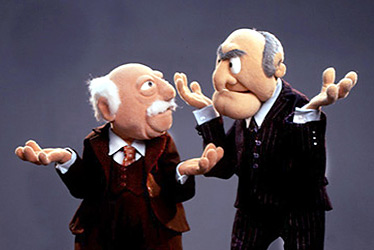
Goldman Sachs is in the news again, this time because a now former executive by the name of Greg Smith wrote a scathing resignation letter published in the New York Times titled Why I Am Leaving Goldman Sachs. In his article, Mr. Smith (who no doubt will be going to Washington when Congress calls for another investigation), accuses his former employer of putting its own interests ahead of its clients'. That may come as a shock to some people, but I would bet that most clients suspected as much anyway.
Mr. Smith says that Goldman's stock in trade for 143 years has been trust. However, he says that today a new culture has taken over, one which stresses "ripping eyeballs out" and "getting paid." Perhaps most interesting was Mr. Smith's claim that during the past 12 months he heard five different directors refer to their clients as "muppets."
Anyone familiar with the real Muppets would know that Misters Statler and Waldorf (pictured above) are the only ones who are wealthy enough to be Goldman clients. Interestingly (and this is no joke), Goldman Sachs has actually arranged financing deals for movie studios trying to raise money from hedge funds and private equity firms. I could find no evidence, however, that Goldman was involved in any of the Muppet movie deals.
In all seriousness, this is just another incident that tarnishes the reputation of Warren Buffett's favorite investment bank. Buffett, who has long been critical of investment bankers, has praised Goldman Sachs on a number of occasions. Berkshire Hathaway still holds a sizable financial interest in Goldman in the form of warrants, an investment that came about during the financial crisis when Buffett was approached by a former Goldman banker named Byron Trott.
One has to wonder what purpose Mr. Smith's public letter of resignation serves. He must have been very angry or fed up to do what he did. It certainly was one of the greatest displays of publicly burning ones bridges. His actions make it all but certain that no other bank will hire him. Yet Mr. Smith is probably wealthy enough to live comfortably for the rest of his life without having to work. I have no doubt, however, that a number of investment firms would be happy to have him on their staff. Yet criticizing Goldman so publicly for unethical behavior will also bring a certain degree of scrutiny on how exactly Mr. Smith has been earning his living over the past 12 years. Because he must know this, he must also be quite confident that he can withstand the scrutiny.
Tweet
Tuesday, March 06, 2012
Earnings Guidance Revisted
Earnings guidance is one of the more controversial management practices. It is something I feel strongly about. I even devoted a whole chapter to defending this practice in my 2008 book, "Even Buffett Isn't Perfect." Those who would like to see an end to guidance are basically arguing that investors are better off having less information. In a day and age when regulators are trying to increase transparency, this makes no sense.
It was wonderful to see the recent Wall Street Journal article written by Professor Baruch Lev of New York University defending guidance. It reminded me of the excellent interview I had with Professor Lev several years ago when he was a guest on the MoneyMasters video program I used to host at Forbes. Click here to watch Professor Lev's excellent defense of earnings guidance.
Tweet
It was wonderful to see the recent Wall Street Journal article written by Professor Baruch Lev of New York University defending guidance. It reminded me of the excellent interview I had with Professor Lev several years ago when he was a guest on the MoneyMasters video program I used to host at Forbes. Click here to watch Professor Lev's excellent defense of earnings guidance.
Tweet
Saturday, March 03, 2012
Stocks Ignore Economic Woes as Apple Drives the Indexes
The following commentary is derived from a Special Report distributed to subscribers of the Forbes Special Situation Survey on March 2.
So far, 2012 is turning out to be a great year for stocks. Through Friday, March 2, the NASDAQ Composite Index was up 14.2% year-to-date and the S&P 500 was up 8.9%. Of course, both indexes benefit greatly from their inclusion of Apple Inc., which is up 34.6% year-to-date. Apple, which has a market capitalization of more than $500 billion, is about one-fourth larger than Exxon Mobil, the second largest stock in the S&P 500. Because both the NASDAQ Composite and the S&P 500 are cap-weighted, they got a big boost from Apple's outstanding performance. On the other hand, the Dow Jones Industrial Average, which does not include Apple, is up just 6.2% year-to-date. This demonstrates just how influential Apple has been to the other two indexes.
For the most part, the corporate sector of the economy is doing well. Companies have benefited greatly from low interest rates and years of cost-cutting. Profits and balance sheets are strong. Many companies are using cash to increase dividends, repurchase shares, and pay down debt (or at least refinance existing debt with cheaper debt). Yet three critical legs of the economy remain troubled.
Employment – On the surface, there appear to be significant improvements in the employment market. The unemployment rate, which peaked at 10% in October 2009, has gradually declined to 8.3%. Weekly initial jobless claims improved from 659,000 in March 2009 to 351,000 for the week ending February 25, 2012. Nonfarm payrolls increased by 243,000 in January, marking the 16th consecutive month that the economy added jobs. There is no question that these trends are good. They certainly indicate that the jobs market is moving in the right direction. However, the improvement in the unemployment rate is largely an aberration because discouraged workers, who are many, are not counted. Furthermore, initial jobless claims are still higher than they should be in a recovery, and job creation is still much too anemic. Take a look at the employment participation rate to see just how troubled the jobs market remains. This figure is calculated by dividing the civilian labor force by the civilian non-institutional population. This critical measure, which hovered above 66% before the financial crisis of 2008, is now down to just 63.7%. In other words, a smaller proportion of the population is taking part in the labor force. If you think there isn't much difference between 66% and 63.7%, you will probably be shocked to learn that had the participation rate remained at 66%, the unemployment rate today would actually be 11.8% instead of 8.3%. As bad as it is, the unemployment rate looks better simply because fewer people are participating in the jobs market. Also, don't forget that if the jobs market truly strengthens, the unemployment rate should initially rise as more people begin to look for work.
Housing – Warren Buffett argues that the housing market is near bottom. He says that over the long term, the number of housing units must rise in line with the number of households. Today, household formation is outpacing the increase in housing units. That doesn't help the housing market in the short term because there is an oversupply of homes. In the long term, however, more houses will have to be built. Furthermore, because interest rates are low and housing prices are so depressed, the cost of buying a home looks extremely attractive compared to the cost of renting. Buffett is right that the housing market will eventually improve. Of course, the critical question is when? Unfortunately, the latest S&P/Case-Shiller numbers show that we aren't there yet. Housing prices are still falling. In fact, they are almost 35% below the 2006 peak. On average, homes today are worth what they were back in early 2003. Many people who purchased a house after that date are underwater.
Energy – According to the AAA Daily Fuel Gauge Report, the national average price of regular gasoline has reached $3.74 per gallon. In some parts of the country, it is well above $4.00 per gallon. Just one month ago, the national average price was $3.45 per gallon. This 8.4% increase in a month is largely due to the rise in crude oil prices. The oil market has been particularly sensitive to rumors. For example, any talk that Israel is about to attack Iran in order to destroy that nation’s nuclear capabilities causes prices to rally. A recent rumor that a pipeline in Saudi Arabia exploded caused another spike in oil prices. Interestingly, that rumor, which turned out to be false, appears to have originated in Iran. That may not be surprising, yet the reaction showed just how nervous oil traders are. Demand for gasoline, which has been depressed since the start of the financial crisis, was starting to pick up. Higher gasoline prices, however, are likely to reduce demand again, which is not a good development for the economy. Higher gasoline prices could also fuel inflation. One energy bright spot is natural gas, which is plentiful, cheap, and not imported. Maybe it's time to start thinking more seriously about alternative sources of energy, such as T. Boone Pickens' idea of converting long-haul trucks to natural gas.
Tweet
So far, 2012 is turning out to be a great year for stocks. Through Friday, March 2, the NASDAQ Composite Index was up 14.2% year-to-date and the S&P 500 was up 8.9%. Of course, both indexes benefit greatly from their inclusion of Apple Inc., which is up 34.6% year-to-date. Apple, which has a market capitalization of more than $500 billion, is about one-fourth larger than Exxon Mobil, the second largest stock in the S&P 500. Because both the NASDAQ Composite and the S&P 500 are cap-weighted, they got a big boost from Apple's outstanding performance. On the other hand, the Dow Jones Industrial Average, which does not include Apple, is up just 6.2% year-to-date. This demonstrates just how influential Apple has been to the other two indexes.
For the most part, the corporate sector of the economy is doing well. Companies have benefited greatly from low interest rates and years of cost-cutting. Profits and balance sheets are strong. Many companies are using cash to increase dividends, repurchase shares, and pay down debt (or at least refinance existing debt with cheaper debt). Yet three critical legs of the economy remain troubled.
Employment – On the surface, there appear to be significant improvements in the employment market. The unemployment rate, which peaked at 10% in October 2009, has gradually declined to 8.3%. Weekly initial jobless claims improved from 659,000 in March 2009 to 351,000 for the week ending February 25, 2012. Nonfarm payrolls increased by 243,000 in January, marking the 16th consecutive month that the economy added jobs. There is no question that these trends are good. They certainly indicate that the jobs market is moving in the right direction. However, the improvement in the unemployment rate is largely an aberration because discouraged workers, who are many, are not counted. Furthermore, initial jobless claims are still higher than they should be in a recovery, and job creation is still much too anemic. Take a look at the employment participation rate to see just how troubled the jobs market remains. This figure is calculated by dividing the civilian labor force by the civilian non-institutional population. This critical measure, which hovered above 66% before the financial crisis of 2008, is now down to just 63.7%. In other words, a smaller proportion of the population is taking part in the labor force. If you think there isn't much difference between 66% and 63.7%, you will probably be shocked to learn that had the participation rate remained at 66%, the unemployment rate today would actually be 11.8% instead of 8.3%. As bad as it is, the unemployment rate looks better simply because fewer people are participating in the jobs market. Also, don't forget that if the jobs market truly strengthens, the unemployment rate should initially rise as more people begin to look for work.
Housing – Warren Buffett argues that the housing market is near bottom. He says that over the long term, the number of housing units must rise in line with the number of households. Today, household formation is outpacing the increase in housing units. That doesn't help the housing market in the short term because there is an oversupply of homes. In the long term, however, more houses will have to be built. Furthermore, because interest rates are low and housing prices are so depressed, the cost of buying a home looks extremely attractive compared to the cost of renting. Buffett is right that the housing market will eventually improve. Of course, the critical question is when? Unfortunately, the latest S&P/Case-Shiller numbers show that we aren't there yet. Housing prices are still falling. In fact, they are almost 35% below the 2006 peak. On average, homes today are worth what they were back in early 2003. Many people who purchased a house after that date are underwater.
Energy – According to the AAA Daily Fuel Gauge Report, the national average price of regular gasoline has reached $3.74 per gallon. In some parts of the country, it is well above $4.00 per gallon. Just one month ago, the national average price was $3.45 per gallon. This 8.4% increase in a month is largely due to the rise in crude oil prices. The oil market has been particularly sensitive to rumors. For example, any talk that Israel is about to attack Iran in order to destroy that nation’s nuclear capabilities causes prices to rally. A recent rumor that a pipeline in Saudi Arabia exploded caused another spike in oil prices. Interestingly, that rumor, which turned out to be false, appears to have originated in Iran. That may not be surprising, yet the reaction showed just how nervous oil traders are. Demand for gasoline, which has been depressed since the start of the financial crisis, was starting to pick up. Higher gasoline prices, however, are likely to reduce demand again, which is not a good development for the economy. Higher gasoline prices could also fuel inflation. One energy bright spot is natural gas, which is plentiful, cheap, and not imported. Maybe it's time to start thinking more seriously about alternative sources of energy, such as T. Boone Pickens' idea of converting long-haul trucks to natural gas.
Tweet
Sunday, February 19, 2012
A Commercial for Singapore

I am still a little jet-lagged after a two-week stint in Singapore teaching an intensive executive class in equity investment management. This was part of the M.S. in Finance program run by the Zicklin School of Business at Baruch College. The students were all business executives. Some were working for large international companies, including Credit Suisse and Barclays. Others were working with local companies. All of them were experienced, smart, hard-working, and motivated.
This was my first visit to Singapore and I was extremely favorably impressed, so please excuse the somewhat promotional nature of this post. I had heard a lot about this small pro-business city-state before going, but nothing beats seeing it with your own eyes. Singapore is very modern, clean, and safe. There is very little crime and you can walk where ever you want without worrying about your safety. Because the country is near the equator, you should be prepared to sweat if you plan to do a lot of walking. Unlike in most American cities, I spotted no litter or graffiti. Of course, the authorities are famous for cracking down hard on violators, but it simply is not in the nature of the population to deface property or throw trash into the streets. People seem to be extremely conscious of how their actions affect others.
I found that most prices were quite similar to those in the U.S., but a few things were clearly much more expensive. For example, a small (or should I say tall) plain cup of coffee from Starbucks costs more than $3.00 U.S. And don't even think about buying a car. A small Toyota would set you back about $80,000 U.S. This is the government's way of controlling traffic. Nonetheless, there were still plenty of nice cars on the streets. However, a car isn't even necessary since public transportation is readily available and taxis are reasonably priced.
Of course, Singapore's biggest draw is its pro-business climate, which includes low taxes. I met with Will Adamopoulos, who heads the Forbes office in Singapore. Will and his family have been living in Singapore for many years. He stressed the rising number of billionaires in Asia. I also met with Mykolas Rambus, CEO of Wealth-X, a company he founded in New York City in 2009. Wealth-X now has eight offices around the world. Mykolas moved his family to Singapore about six months ago. Other well-known residents include Eduardo Saverin, co-founder of Facebook, and billionaire investor Jim Rogers.
Singapore often shows up at the top of the world rankings of best places to conduct business. The International Finance Corporation and the World Bank rank Singapore #1 in their Doing Business 2012 report. Anyone interested in getting started can refer to the website, Guide Me Singapore.
Unfortunately, I missed the famous Singapore Airshow. It got underway the day after I left to return home. I probably would not have been able to get a ticket anyway. They sold out quickly. Fortunately, the Airshow was extremely profitable for Boeing, which scored a $22.4 billion contract with Indonesia's Lion Air for 230 new jet planes. This deal certainly highlights the growing importance of Asia in the global economy. And with the rest of the world in an economic slump, American companies that want to grow must increasingly turn their focus to Asia.
Sunday, January 29, 2012
Review of The Vig
The internet is changing all kinds of businesses. It seems that no industry can escape its disruptive force. Publishing is perhaps one of the hardest hit industries. The internet's transformation of publishing started with how books were sold. It then transformed how newspapers and magazines are published and read. Now it is affecting the actual publication of books.
Not long ago, a would-be author would submit a manuscript to a publishing company. If he wanted to increase his chances of being taken seriously, he would hire an agent to try to sell the book on his behalf. However, traditional publishers don't want to take chances on unknown authors unless they feel fairly sure that a minimum number of books can be sold. If the author is a motivational speaker with a strong following or a celebrity with many fans, publishers know the book has a ready audience. A book by these kinds of authors will sell whether it is good or bad. For anyone else, however, it is almost impossible to get published by the traditional route.
However, today's promising authors are no longer at the mercy of the traditional publishing houses. Instead, they can self publish their works and put them up for sale through online retailers such as Amazon.com. Of course, many self-published books are of poor quality. Yet every once in a while, you come across a gem. That's how I would describe John Nuckel's new book, The Vig. In full disclosure, I probably would never have read this book if I did not know the author personally. While this makes me less than perfectly objective, I have to say that despite some minor flaws, I really did enjoy reading The Vig.
For those not in the know, "vig" is short for "vigorish," a term traditionally used to describe a bookie's commission. Nuckel, a former options trader at the American Stock Exchange, uses the term to describe an illegal scheme designed by the characters in his book to skim a little out of the accounts of the traders every day.
The book begins on September 11, 2001. Nuckel, who was present when the World Trade Center towers came crashing down, actually witnessed the horrific scenes of death and destruction that he describes through the eyes of the book's protagonist, a floor trader whose mind is as sharp as a calculator. When the trader is able to return to work, he realizes that something is not quite right with his accounts. They seem to be just a little off. He starts asking questions, which result in a whirlwind of murder, mystery, and intrigue. The author is especially deft at character development. One unsavory criminal doesn't hesitate to murder his own brother. A sexy female assassin is as cold blooded as any assassin literature has produced.
The book's flaws mainly involve minor copy editing issues that do not prevent the reader from enjoying the read. In fact, the book really is hard to put down. It grabs your attention immediately and it doesn't let go. At 194 pages, The Vig is a relatively quick read. While some readers may find the details of floor trading and arbitrage a little hard to follow, anyone interested in investing will enjoy those sections as much as the others. I liked this book very much and I recommend it strongly.
Not long ago, a would-be author would submit a manuscript to a publishing company. If he wanted to increase his chances of being taken seriously, he would hire an agent to try to sell the book on his behalf. However, traditional publishers don't want to take chances on unknown authors unless they feel fairly sure that a minimum number of books can be sold. If the author is a motivational speaker with a strong following or a celebrity with many fans, publishers know the book has a ready audience. A book by these kinds of authors will sell whether it is good or bad. For anyone else, however, it is almost impossible to get published by the traditional route.
However, today's promising authors are no longer at the mercy of the traditional publishing houses. Instead, they can self publish their works and put them up for sale through online retailers such as Amazon.com. Of course, many self-published books are of poor quality. Yet every once in a while, you come across a gem. That's how I would describe John Nuckel's new book, The Vig. In full disclosure, I probably would never have read this book if I did not know the author personally. While this makes me less than perfectly objective, I have to say that despite some minor flaws, I really did enjoy reading The Vig.
For those not in the know, "vig" is short for "vigorish," a term traditionally used to describe a bookie's commission. Nuckel, a former options trader at the American Stock Exchange, uses the term to describe an illegal scheme designed by the characters in his book to skim a little out of the accounts of the traders every day.
The book begins on September 11, 2001. Nuckel, who was present when the World Trade Center towers came crashing down, actually witnessed the horrific scenes of death and destruction that he describes through the eyes of the book's protagonist, a floor trader whose mind is as sharp as a calculator. When the trader is able to return to work, he realizes that something is not quite right with his accounts. They seem to be just a little off. He starts asking questions, which result in a whirlwind of murder, mystery, and intrigue. The author is especially deft at character development. One unsavory criminal doesn't hesitate to murder his own brother. A sexy female assassin is as cold blooded as any assassin literature has produced.
The book's flaws mainly involve minor copy editing issues that do not prevent the reader from enjoying the read. In fact, the book really is hard to put down. It grabs your attention immediately and it doesn't let go. At 194 pages, The Vig is a relatively quick read. While some readers may find the details of floor trading and arbitrage a little hard to follow, anyone interested in investing will enjoy those sections as much as the others. I liked this book very much and I recommend it strongly.
Tuesday, January 24, 2012
Mitt Romney and Taxes
I have a tendency to avoid watching presidential debates, primarily because I'm convinced that the best debater does not necessarily make the best president. Of course, debates can be quite entertaining; however, they tell us more about how well a candidate can think on his feet than they do about what he really stands for. In addition, one mistake in a debate could kill an entire campaign. Witness Rick Perry's inability to recall one of three departments he would shut down if elected president.
Nonetheless, the topic du jour is Mitt and Ann Romney's taxes. It has become a big issue, largely due to Mitt Romney's unwillingness to release information about his tax returns earlier in the campaign, as well as his inability to properly defend what he actually pays in taxes.
So instead of relying on what is being reported in the media, I decided to take a look at the Romney's just-released tax returns. In 2010, Mitt and Ann Romney reported interest income of $3,295,727. Interestingly, only $557 of that amount was non-taxable. Obviously, they are not big buyers of municipal bonds. The Romneys also reported $4,923,348 in dividend income. Of this amount, $3,327,678 were considered qualified dividends, meaning they were taxed at the lowest rate of 15%.
The Romneys also had quite a lot of capital gains, in fact $12,573,249 worth. Most of the capital gains were of the long-term variety, which means they, too, were taxed at the lowest rate of 15%. Making some relatively minor adjustments, the Romney's total adjusted gross income for 2010 was $21,646,507. That's certainly a lot of dough by almost anyone's standards.
It turns out the Romneys are also very charitable people. In fact, they donated $2,983,974 to charity in 2010. Their total allowable itemized deductions came out to $4,519,140. Including their exemptions, their taxable income was $17,120,067. Their total tax bill (which includes the alternative minimum tax, self-employment tax, tax on IRA or 401(k) income, and a credit for foreign taxes paid) came out to $3,009,766. In other words, their tax rate was 17.6% of their taxable income. This is higher than the 14% tax rate widely reported in the media. The difference is explained by the fact that the media is calculating the tax rate on adjusted gross income rather than the tax rate on taxable income. But the media's calculation is misleading because it ignores things such as charitable contributions.
The Romneys also released projections of their tax return for 2011. Even though they increased their charitable contributions, their tax rate on taxable income is actually expected to rise to 21.2% for 2011, quite a bit higher than it was in 2010.
Here are two points that Mitt Romney needs to articulate better: 1) One reason the Romneys' tax rate appears low (as a percentage of adjusted gross income) is because they have been extremely charitable. If the Romneys had not donated so much money to charity, their tax rate would be substantially higher. 2) A second reason their tax rate appears low is because the vast majority of their income is in the form of qualified dividends and capital gains.
Some will argue that it isn't fair to tax capital gains and qualified dividends at a lower rate than ordinary income. I would argue that it isn't fair to tax this kind of income at all. Why? Because it has already been taxed at the corporate level. Taxing corporations is exactly the same thing as taxing shareholders directly. When corporations pay taxes, there is less money left over for the shareholders.
When a corporation hires an employee, that employee's salary is a tax-deductible expense for the corporation. As a result, it is perfectly fair to tax that employee's wages at the ordinary rate. However, when a corporation pays dividends, that money comes from after-tax earnings. When the stock price rises creating capital gains, those gains represent the after-tax performance of the corporation. If corporations were not taxed at all, the sum of the dividends and capital gains would be much larger than they are now. In that case, it would be perfectly fair to tax dividends and capital gains at the ordinary rate.
As things currently stand, the effective tax rate on dividends and capital gains is actually much higher than the effective tax rate on ordinary income. This is because the effective tax rate is actually equal to the tax rate that corporations pay plus the tax rate that individuals pay on dividends and capital gains, a figure that is closer to 50%, and much higher when state taxes are taken into account.
I have long been an advocate for a simplified tax code. Our current tax code has become so convoluted and confusing that only expert accountants can make heads or tails out of it. Furthermore, our current code fools large numbers of people into believing that the rich pay less taxes than the poor. In my perfect world, I would eliminate the tax on corporations (which would also eliminate the incentive that corporations currently have to finance themselves with tax-deductible debt). I would also eliminate ALL tax deductions (including those for mortgage interest and charitable contributions). Finally, I would introduce one low flat tax rate on all income. Although I would hate to do it, I would even be willing to go along with mildly progressive tax rates. All of this could be done in a revenue neutral manner. Yet I wouldn't hold my breath. With so many groups lobbying Congress for one exception or another, I don't really expect any of this to become reality. On the contrary, if I had to bet money, I would bet that the tax code will only get more and more convoluted as time goes on.
Tweet
Nonetheless, the topic du jour is Mitt and Ann Romney's taxes. It has become a big issue, largely due to Mitt Romney's unwillingness to release information about his tax returns earlier in the campaign, as well as his inability to properly defend what he actually pays in taxes.
So instead of relying on what is being reported in the media, I decided to take a look at the Romney's just-released tax returns. In 2010, Mitt and Ann Romney reported interest income of $3,295,727. Interestingly, only $557 of that amount was non-taxable. Obviously, they are not big buyers of municipal bonds. The Romneys also reported $4,923,348 in dividend income. Of this amount, $3,327,678 were considered qualified dividends, meaning they were taxed at the lowest rate of 15%.
The Romneys also had quite a lot of capital gains, in fact $12,573,249 worth. Most of the capital gains were of the long-term variety, which means they, too, were taxed at the lowest rate of 15%. Making some relatively minor adjustments, the Romney's total adjusted gross income for 2010 was $21,646,507. That's certainly a lot of dough by almost anyone's standards.
It turns out the Romneys are also very charitable people. In fact, they donated $2,983,974 to charity in 2010. Their total allowable itemized deductions came out to $4,519,140. Including their exemptions, their taxable income was $17,120,067. Their total tax bill (which includes the alternative minimum tax, self-employment tax, tax on IRA or 401(k) income, and a credit for foreign taxes paid) came out to $3,009,766. In other words, their tax rate was 17.6% of their taxable income. This is higher than the 14% tax rate widely reported in the media. The difference is explained by the fact that the media is calculating the tax rate on adjusted gross income rather than the tax rate on taxable income. But the media's calculation is misleading because it ignores things such as charitable contributions.
The Romneys also released projections of their tax return for 2011. Even though they increased their charitable contributions, their tax rate on taxable income is actually expected to rise to 21.2% for 2011, quite a bit higher than it was in 2010.
Here are two points that Mitt Romney needs to articulate better: 1) One reason the Romneys' tax rate appears low (as a percentage of adjusted gross income) is because they have been extremely charitable. If the Romneys had not donated so much money to charity, their tax rate would be substantially higher. 2) A second reason their tax rate appears low is because the vast majority of their income is in the form of qualified dividends and capital gains.
Some will argue that it isn't fair to tax capital gains and qualified dividends at a lower rate than ordinary income. I would argue that it isn't fair to tax this kind of income at all. Why? Because it has already been taxed at the corporate level. Taxing corporations is exactly the same thing as taxing shareholders directly. When corporations pay taxes, there is less money left over for the shareholders.
When a corporation hires an employee, that employee's salary is a tax-deductible expense for the corporation. As a result, it is perfectly fair to tax that employee's wages at the ordinary rate. However, when a corporation pays dividends, that money comes from after-tax earnings. When the stock price rises creating capital gains, those gains represent the after-tax performance of the corporation. If corporations were not taxed at all, the sum of the dividends and capital gains would be much larger than they are now. In that case, it would be perfectly fair to tax dividends and capital gains at the ordinary rate.
As things currently stand, the effective tax rate on dividends and capital gains is actually much higher than the effective tax rate on ordinary income. This is because the effective tax rate is actually equal to the tax rate that corporations pay plus the tax rate that individuals pay on dividends and capital gains, a figure that is closer to 50%, and much higher when state taxes are taken into account.
I have long been an advocate for a simplified tax code. Our current tax code has become so convoluted and confusing that only expert accountants can make heads or tails out of it. Furthermore, our current code fools large numbers of people into believing that the rich pay less taxes than the poor. In my perfect world, I would eliminate the tax on corporations (which would also eliminate the incentive that corporations currently have to finance themselves with tax-deductible debt). I would also eliminate ALL tax deductions (including those for mortgage interest and charitable contributions). Finally, I would introduce one low flat tax rate on all income. Although I would hate to do it, I would even be willing to go along with mildly progressive tax rates. All of this could be done in a revenue neutral manner. Yet I wouldn't hold my breath. With so many groups lobbying Congress for one exception or another, I don't really expect any of this to become reality. On the contrary, if I had to bet money, I would bet that the tax code will only get more and more convoluted as time goes on.
Tweet
Friday, January 13, 2012
Discounting the Trade Deficit
Today, the Census Bureau released trade figures for the month of November. The deficit grew to $47.752 billion in November, up from $43.271 billion in October and much larger than the consensus expectation of $44.0 billion. A larger deficit is a subtraction from GDP, but a larger deficit does not necessarily mean the economy is in trouble. For example, the deficit would increase if the increase in imports is greater than the increase in exports. Yet if both are increasing, the economy could be doing fine. Unfortunately, that wasn't the case in this report. The report showed that imports increased by $2.947 billion in November while exports decreased by $1.535 billion.
The good news is that the report tells us what happened two months ago. As a result, it may not be giving us a good indication of what is happening now. Other economic figures indicate that the economy is improving. Nonfarm payrolls, housing starts, and consumer sentiment are moving in the right direction. While today's trade report is not consistent with an improving economy, we shouldn't put too much weight on it.
The good news is that the report tells us what happened two months ago. As a result, it may not be giving us a good indication of what is happening now. Other economic figures indicate that the economy is improving. Nonfarm payrolls, housing starts, and consumer sentiment are moving in the right direction. While today's trade report is not consistent with an improving economy, we shouldn't put too much weight on it.
Wednesday, January 04, 2012
2012 Should Be Better Than 2011
I spoke with Tracy Byrnes at Fox News about a couple of issues including the tendency for stocks to rally in January and why I think 2012 could be a better year than 2011 was for U.S. stocks. You can see the discussion here.
Wednesday, December 21, 2011
RIMM Hangs Up on Amazon, Microsoft, and Nokia
It is difficult to find a stock that is more out of favor than Research in Motion (RIMM), the company best known for the BlackBerry smartphone. RIMM is led by a pair of co-CEOs, a highly unusual arrangement for any publicly-traded company and one that has proven extremely ineffective in recent periods. This dysfunctional structure has resulted in one misstep after another. In particular, the company has delayed the launch of key new models and new software a number of times. RIMM also had a disastrous launch of its tablet computer dubbed the PlayBook. Although some experts claim the PlayBook is technologically superior to other tablets, consumers complain that there are too few apps.
It turns out that at least a few companies thought RIMM was worth buying. While it isn't clear if any formal offers were made, Amazon.com, Microsoft, and Nokia were all recently mentioned in press reports as possible suitors. In any case, it seems that RIMM's co-CEOs weren't keen to be bought out. They apparently refused to entertain any offers. Instead, they continue to believe that they can orchestrate a turnaround by themselves.
Whether they will succeed or not remains to be seen. What is clear, however, is that RIMM is no Lehman Brothers. Although the company is losing market share in the U.S., it is still a leader in several key international markets. In fact, the company's subscriber base actually surged 35% year-over-year during the most recently completed quarter. The board of directors will release a report in January that is widely expected to recommend some drastic changes.
Management has been begging investors to exercise a little more patience. Instead, investors have been selling the stock. Today's news caused the stock to rally. The fact that any company sees value in RIMM is giving investors some assurance--at least for now. In any case, it is much too early to write RIMM's obituary. Despite reduced earnings expectations ($4.10 per share for fiscal 2012), with absolutely no debt on the books, well over a $1 billion in cash, and the real possibility of a management shake up, RIMM is worth a second look.
Disclosure - Vahan Janjigian holds RIMM in portfolios he manages.
Tweet
It turns out that at least a few companies thought RIMM was worth buying. While it isn't clear if any formal offers were made, Amazon.com, Microsoft, and Nokia were all recently mentioned in press reports as possible suitors. In any case, it seems that RIMM's co-CEOs weren't keen to be bought out. They apparently refused to entertain any offers. Instead, they continue to believe that they can orchestrate a turnaround by themselves.
Whether they will succeed or not remains to be seen. What is clear, however, is that RIMM is no Lehman Brothers. Although the company is losing market share in the U.S., it is still a leader in several key international markets. In fact, the company's subscriber base actually surged 35% year-over-year during the most recently completed quarter. The board of directors will release a report in January that is widely expected to recommend some drastic changes.
Management has been begging investors to exercise a little more patience. Instead, investors have been selling the stock. Today's news caused the stock to rally. The fact that any company sees value in RIMM is giving investors some assurance--at least for now. In any case, it is much too early to write RIMM's obituary. Despite reduced earnings expectations ($4.10 per share for fiscal 2012), with absolutely no debt on the books, well over a $1 billion in cash, and the real possibility of a management shake up, RIMM is worth a second look.
Disclosure - Vahan Janjigian holds RIMM in portfolios he manages.
Tweet
Friday, December 02, 2011
Unemployment vs. Participation: Which Shows a Truer Picture?
Equity futures were up strongly this morning thanks to reports that the International Monetary Fund would get involved to help resolve the European debt crisis. Futures remained strong when the U.S. employment report came out showing a big drop in the unemployment rate. The unemployment rate, however, is misleading and by early afternoon, stocks gave up much of their gains as investors looked deeper into the numbers.
According to the Bureau of Labor Statistics, nonfarm payrolls rose by 120,000 in November. Nonfarm private payrolls rose by 140,000. Both figures were close to the consensus estimates and they show that the economy is creating jobs, albeit at an anemic pace. The big surprise, however, was the dramatic decline in the unemployment rate. It fell to 8.6%, much better than the consensus estimate of 9.0%. While this grabbed the headlines, things beneath the surface don't look as rosy.
The unemployment rate is defined as the number of unemployed (but looking for work) divided by the civilian labor force. As a result, the unemployment rate can improve simply because fewer people are looking for jobs. This can happen when they get discouraged and drop out of the labor force.
A better measure of the state of employment is the participation rate. This rate divides the civilian labor force by the civilian noninstitutional population. The denominator includes everyone aged 16 and over who is not institutionalized, meaning that they are not in the military, jail, mental institution, or home for the aged. Everyone else is considered capable of working. Of course, some people have legitimate reasons not to work. Perhaps they are still in school, or they prefer to stay at home with the kids, or they have retired. As a result, the participation rate will always be below 100%; however, in a healthy economy, it should be somewhere near 70%.
The bad news is that the participation rate fell from 64.2% in October to 64.0% in November. In fact, as shown in the figure below, this rate has been declining steadily for quite some time.

I don't want to throw cold water on today's jobs report. The nonfarm payroll figures are somewhat encouraging and at least they show that the economy is moving in the right direction. However, don't get fooled by the lower unemployment rate. It may make some people in the White House feel a little better, but the economy won't be out of the woods until the participation rate improves significantly.
I had a discussion in late October about this with Karen Gibbs in Chicago. Interestingly, MoneyShow decided to release the video today in conjunction with the employment report. As you'll see in the video, I stress the importance of focusing on the the participation rate.
Tweet
According to the Bureau of Labor Statistics, nonfarm payrolls rose by 120,000 in November. Nonfarm private payrolls rose by 140,000. Both figures were close to the consensus estimates and they show that the economy is creating jobs, albeit at an anemic pace. The big surprise, however, was the dramatic decline in the unemployment rate. It fell to 8.6%, much better than the consensus estimate of 9.0%. While this grabbed the headlines, things beneath the surface don't look as rosy.
The unemployment rate is defined as the number of unemployed (but looking for work) divided by the civilian labor force. As a result, the unemployment rate can improve simply because fewer people are looking for jobs. This can happen when they get discouraged and drop out of the labor force.
A better measure of the state of employment is the participation rate. This rate divides the civilian labor force by the civilian noninstitutional population. The denominator includes everyone aged 16 and over who is not institutionalized, meaning that they are not in the military, jail, mental institution, or home for the aged. Everyone else is considered capable of working. Of course, some people have legitimate reasons not to work. Perhaps they are still in school, or they prefer to stay at home with the kids, or they have retired. As a result, the participation rate will always be below 100%; however, in a healthy economy, it should be somewhere near 70%.
The bad news is that the participation rate fell from 64.2% in October to 64.0% in November. In fact, as shown in the figure below, this rate has been declining steadily for quite some time.

I don't want to throw cold water on today's jobs report. The nonfarm payroll figures are somewhat encouraging and at least they show that the economy is moving in the right direction. However, don't get fooled by the lower unemployment rate. It may make some people in the White House feel a little better, but the economy won't be out of the woods until the participation rate improves significantly.
I had a discussion in late October about this with Karen Gibbs in Chicago. Interestingly, MoneyShow decided to release the video today in conjunction with the employment report. As you'll see in the video, I stress the importance of focusing on the the participation rate.
Tweet
Thursday, December 01, 2011
Retail Investors Staying Away From Stocks
Bank of America recently conducted a survey of about 1,000 "mass affluent" investors. The results are found in its Merrill Edge Report: November 2011.
The mass affluent are defined as people who have $50,000 to $250,000 in investable assets. These people are not rich. In fact, they are solidly in the middle class. They are extremely important because there are so many of them and they form the backbone of the investing public. An estimated 28 million households fall into this category. That's about a quarter of total U.S. households.
Some of the findings are encouraging. For example, about a quarter of those surveyed said their financial situation is better than it was a year ago because they are spending less, paying bills on time, and sticking with a budget. Other results, however, are worrisome. More than a quarter of the respondents said they are dipping into savings to meet short-term needs and they are neglecting their long-term goals. Almost half think they will retire later than they had hoped just a year ago, and more than 40% have become more conservative with their investments.
Interestingly, these people are taking less risk with their investments at a time when the Federal Reserve is trying to encourage risk taking. These people would rather hold cash, which pays little or no interest, than take the risk of losing money in the stock market. I discussed some of this with Tracy Byrnes today on Fox Business.
Tweet
The mass affluent are defined as people who have $50,000 to $250,000 in investable assets. These people are not rich. In fact, they are solidly in the middle class. They are extremely important because there are so many of them and they form the backbone of the investing public. An estimated 28 million households fall into this category. That's about a quarter of total U.S. households.
Some of the findings are encouraging. For example, about a quarter of those surveyed said their financial situation is better than it was a year ago because they are spending less, paying bills on time, and sticking with a budget. Other results, however, are worrisome. More than a quarter of the respondents said they are dipping into savings to meet short-term needs and they are neglecting their long-term goals. Almost half think they will retire later than they had hoped just a year ago, and more than 40% have become more conservative with their investments.
Interestingly, these people are taking less risk with their investments at a time when the Federal Reserve is trying to encourage risk taking. These people would rather hold cash, which pays little or no interest, than take the risk of losing money in the stock market. I discussed some of this with Tracy Byrnes today on Fox Business.
Tweet
Friday, November 18, 2011
How Much Cash Does Apple Have?
Commentators sometimes make exaggerated remarks about the amount of cash Apple Inc. holds. The figure often cited is that Apple has about $80 billion in cash. That's not quite right, but this is how they arrive at that number.
According to the company's recently filed 10-K, Apple actually has $9.8 billion in cash and cash equivalents. It also holds another $16.1 billion in short-term marketable securities. Although these securities are not exactly cash, they can be converted into cash rather quickly if needed. Including short-term marketable securities in the mix is not unusual. So that brings us to about $26 billion. In addition to this, Apple also has $55.6 billion invested in long-term marketable securities. These securities are less cash-like than short-term marketable securities. It is true that they could be sold and converted into cash, but so could any long-term asset. It isn't quite right to classify long-term assets, even the ones that are marketable, as cash. Nonetheless, the total of cash, cash equivalents, and marketable securities (both short and long term) does come out $81.6 billion, or approximately $87.70 per share of outstanding common stock. Any way you look at it, that's a lot of dough.
Where is all this money invested? Apple holds U.S. Treasury and agency securities, foreign government securities, certificates of deposit, commercial paper, corporate securities, and municipal securities. The company's 10-K states that in fiscal 2011, the entire amount earned a weighted average interest rate of 0.77%! Can Apple find no better use for this money? Perhaps a dividend is in order.
By the way, Apple says $54.3 billion of the total is held by foreign subsidiaries. This money would be subject to U.S. taxes of as much as 35% if Apple ever tried to repatriate it. But the tax would not end there. If Apple repatriated the money and then paid a dividend, shareholders would have to pay an additional tax. Is it any wonder that the company is sitting on so much money earning next to nothing? It is high time for Congress to revisit this inane tax policy.
Tweet
According to the company's recently filed 10-K, Apple actually has $9.8 billion in cash and cash equivalents. It also holds another $16.1 billion in short-term marketable securities. Although these securities are not exactly cash, they can be converted into cash rather quickly if needed. Including short-term marketable securities in the mix is not unusual. So that brings us to about $26 billion. In addition to this, Apple also has $55.6 billion invested in long-term marketable securities. These securities are less cash-like than short-term marketable securities. It is true that they could be sold and converted into cash, but so could any long-term asset. It isn't quite right to classify long-term assets, even the ones that are marketable, as cash. Nonetheless, the total of cash, cash equivalents, and marketable securities (both short and long term) does come out $81.6 billion, or approximately $87.70 per share of outstanding common stock. Any way you look at it, that's a lot of dough.
Where is all this money invested? Apple holds U.S. Treasury and agency securities, foreign government securities, certificates of deposit, commercial paper, corporate securities, and municipal securities. The company's 10-K states that in fiscal 2011, the entire amount earned a weighted average interest rate of 0.77%! Can Apple find no better use for this money? Perhaps a dividend is in order.
By the way, Apple says $54.3 billion of the total is held by foreign subsidiaries. This money would be subject to U.S. taxes of as much as 35% if Apple ever tried to repatriate it. But the tax would not end there. If Apple repatriated the money and then paid a dividend, shareholders would have to pay an additional tax. Is it any wonder that the company is sitting on so much money earning next to nothing? It is high time for Congress to revisit this inane tax policy.
Tweet
Thursday, November 17, 2011
Defense Stocks Could Rally on Supercommittee Compromise
The so-called supecommittee, tasked with finding a way to reduce the national debt by at least $1.2 trillion over 10 years, is facing a looming deadline. It it fails to agree on a proposal by November 23, there will be automatic spending cuts. There are those who would welcome such a dire outcome. The problem is that some of those automatic cuts would put our national security at risk. Defense Secretary Leon Panetta warned that such cuts would be devastating.
For this reason, I am still hopeful that the committee will find some resolution. It is difficult to believe that even the most partisan politician would be willing to put our nation at risk. If a compromise is reached, defense stocks could rally. Some of my favorites include Raytheon (RTN), ManTech International (MANT), and ITT Exelis (XLS). All three also pay generous dividends.
Tweet
For this reason, I am still hopeful that the committee will find some resolution. It is difficult to believe that even the most partisan politician would be willing to put our nation at risk. If a compromise is reached, defense stocks could rally. Some of my favorites include Raytheon (RTN), ManTech International (MANT), and ITT Exelis (XLS). All three also pay generous dividends.
Tweet
Monday, November 14, 2011
Should You Mimic Buffett?
A few years ago, a couple of academic scholars did some research on Warren Buffett's trades. Their paper, entitled Imitation is the Sincerest Form of Flattery, concluded that investors could indeed have earned excess returns simply by buying the same stocks Warren Buffett bought for Berkshire Hathaway. This is true even if they bought the stocks after the information became public.
In today's interview with CNBC I discuss some of Buffett's recent investments, including IBM, and explain why it matters if Buffett is actually buying the common stock or if he is making a private investment in public equity (PIPE).
Tweet
In today's interview with CNBC I discuss some of Buffett's recent investments, including IBM, and explain why it matters if Buffett is actually buying the common stock or if he is making a private investment in public equity (PIPE).
Tweet
Wednesday, November 09, 2011
Supercommittee Rally?
The conventional wisdom says the Supercommittee, charged with finding a way to reduce the deficit by $1.2 trillion over 10 years, will not be able to reach a compromise. If they don't, automatic spending cuts will go into effect. Cuts to defense spending would put this nation's security at risk. That's why I believe (at least hope) that the committee will put forth a reasonable proposal. The result would be a surprise rally in defense stocks. Read more at MarketWatch.
Tweet
Tweet
Subscribe to:
Posts (Atom)