Fed Chairman Ben Bernanke delivered his much anticipated speech in Jackson Hole, Wyoming this morning. I have criticized Bernanke for his reluctance to make clear that the economy's problems must be addressed through fiscal reforms. Well, today he spoke up strongly about that. Bernanke said, "Uncertainties about fiscal policy, notably about the resolution of the so-called fiscal cliff and the lifting of the debt ceiling, are probably also restraining activity, although the magnitudes of these effects are hard to judge. It is critical that fiscal policymakers put in place a credible plan that sets the federal budget on a sustainable trajectory in the medium and longer runs."
Thanks, Ben, for making that clear. The market rallied in response to Bernanke's remarks, but not because he called for fiscal reforms. It rallied because, once again, the Chairman implied that more monetary stimulus could come. To critics (like me) who believe the economy's problems are not due to high interest rates, Bernanke said, "Early in my tenure as a member of the Board of Governors, I gave a speech that considered options for monetary policy when the short-term policy interest rate is close to its effective lower bound. I was reacting to common assertions at the time that monetary policymakers would be 'out of ammunition' as the federal funds rate came closer to zero. I argued that, to the contrary, policy could still be effective near the lower bound. Now, with several years of experience with nontraditional policies both in the United States and in other advanced economies, we know more about how such policies work. It seems clear, based on this experience, that such policies can be effective."
I would say such policies were not nearly as effective as changes to fiscal policies would have been, but that's beside the point. The point is that Bernanke is saying that despite near zero interest rates, he believes that even more quantitative easing will help. Does this mean he will actually do more? These two sentences from the speech answer that question. "Over the past five years, the Federal Reserve has acted to support economic growth and foster job creation, and it is important to achieve further progress, particularly in the labor market. Taking due account of the uncertainties and limits of its policy tools, the Federal Reserve will provide additional policy accommodation as needed to promote a stronger economic recovery and sustained improvement in labor market conditions in a context of price stability."
Bernanke is giving Congress cover. He says fiscal reforms are a must, but he also says more quantitative easing will help. Let there be no doubt. QE3 is on the way.
Friday, August 31, 2012
Two Interesting Papers From NBER
I noticed a couple of interesting working papers on the National Bureau of Economic Research (NBER) website. The first (NBER Working Paper No. 18075) has to do with how changes in housing wealth affect college choice. You might expect that as the value of a family's home grows, the more likely that family is to send their child to a better (and more expensive) school. Indeed, Michael Lovenheim of Cornell University and Lockwood Reynolds of Kent State University document that for every $10,000 increase in housing wealth, the probability of attending an elite public university increases by two percent. Furthermore, they found that the effect is strongest for the lowest income homeowners. However, their study was limited to the 1993-2003 time period, which is well before the housing bust began. It would be interesting to see what has happened to college choice now that so many homeowners are under water on their mortgages. It would also be interesting to see what is going on at the very expensive elite private universities. I suspect only the very poor and very rich are able to attend these kinds of schools. The very rich, of course, don't really care how high tuition goes. They are more than happy to write a big check to send Johnny to a top school. As for the poor, they are eligible for all kinds of grants. (Harvard, for example, waives tuition for students coming from families that make less than $60,000 per year). As is usually the case, it is the middle class that gets squeezed. They are considered too well off to qualify for grants, yet they are not well off enough to be immune to the pain of writing a large tuition check.
The second paper (NBER Working Paper No. 18035) has to do with how recent recessions have affected the income of the wealthy. Conventional wisdom says that the wealthy are immune to recessions. No matter what happens, they continue to roll in the big bucks. Indeed, the authors, Fatih Guvenen, Serdar Ozkan, and Jae Song argue that in past recessions, lower income individuals suffered larger drops in income than did the very rich. They find, however, that just the opposite occurred during the most recent two recessions. I suspect the authors' findings may be related to sources of income. For example, the very rich are more likely than the poor to generate a substantial amount of income from interest, dividends, and capital gains. The most recent recessions, of course, have decimated investment income. With interest rates so low, interest income has all but disappeared; and income from dividends have not made up for large capital losses. Some people might applaud the low interest rate environment and the toll it is taking on wealthy savers. They should not rejoice. Low interest rates punish every saver (rich or poor) who is trying to plan for the future.
The second paper (NBER Working Paper No. 18035) has to do with how recent recessions have affected the income of the wealthy. Conventional wisdom says that the wealthy are immune to recessions. No matter what happens, they continue to roll in the big bucks. Indeed, the authors, Fatih Guvenen, Serdar Ozkan, and Jae Song argue that in past recessions, lower income individuals suffered larger drops in income than did the very rich. They find, however, that just the opposite occurred during the most recent two recessions. I suspect the authors' findings may be related to sources of income. For example, the very rich are more likely than the poor to generate a substantial amount of income from interest, dividends, and capital gains. The most recent recessions, of course, have decimated investment income. With interest rates so low, interest income has all but disappeared; and income from dividends have not made up for large capital losses. Some people might applaud the low interest rate environment and the toll it is taking on wealthy savers. They should not rejoice. Low interest rates punish every saver (rich or poor) who is trying to plan for the future.

Tuesday, August 28, 2012
Housing Market Improves Marginally

There has been a lot of talk in recent weeks about the improving housing market. One of the most closely followed indicators, the S&P/Case-Shiller Index, came out today. The results were consistent with the thesis that the housing market is improving. The 20-City Composite index showed marginal improvement on both a month-over-month and a year-over-year basis. Indeed, the numbers have been improving for five months in a row. (See the tail end of the chart above.) Because Case-Shiller is delayed by almost two months, the most recent figures reflect sales in June. As a result, it is entirely possible that the housing market is actually stronger than what the latest numbers indicate.
Keep in mind that Case-Shiller does not examine new home sales. It examines repeat sales of existing homes only. Since the existing home market is much larger than the new home market, the improving figures are all the more encouraging. Despite the improvement, however, the gains are minuscule and the index remains depressed. In fact, the year-over-year gain was less than one-half of one percent. The Case-Shiller index remains 32% below the all-time high set in April 2006. According to the index, on average, homes purchased after June 2003 are now worth less than they were then.
Despite the most recent improvements, housing prices are not about to escalate. The most we can say for now is that the declines might be over. We would need to see much stronger job creation before any meaningful housing appreciation occurs.
Sunday, August 26, 2012
A (Tall) Tale of Two Armstrongs
This has been a tough week for folks named Armstrong. First, Lance announced that he was giving up his fight to prove that he didn't take performance-enhancing drugs. He was immediately stripped of his seven Tour de France titles. Those victories will be awarded to the "clean" runners up, no matter how deep they have to go to find them.
After the news about Lance, we learned that Neil passed away. Of course, Neil is famous for being the first man to walk on the moon. But soon after Neil's death, it was revealed that he, too, had dabbled with performance-enhancing drugs. Some experts believe this gave him an edge, allowing him to beat Buzz Aldrin out of the escape hatch of their spacecraft. It seems that Neil will be stripped of his title. From now on Buzz will be known as the First Man to Walk on the Moon, assuming of course that he was clean.
After the news about Lance, we learned that Neil passed away. Of course, Neil is famous for being the first man to walk on the moon. But soon after Neil's death, it was revealed that he, too, had dabbled with performance-enhancing drugs. Some experts believe this gave him an edge, allowing him to beat Buzz Aldrin out of the escape hatch of their spacecraft. It seems that Neil will be stripped of his title. From now on Buzz will be known as the First Man to Walk on the Moon, assuming of course that he was clean.
Speak the Truth Ben
On August 1, Darrell Issa, Chairman of the Congressional Committee on Oversight and Reform, wrote a 10-page letter to Ben Bernanke, Chairman of the Board of Governors of the Federal Reserve System. In this letter, Issa asked 22 specific questions about the economy and what it takes to bring it out of its current malaise. Issa extensively cited the opinions of Allan Meltzer (an economics professor at Carnegie Mellon University), David Stockman (former Director of the Office of Management and Budget), and Andy Kessler (a noted investor). All three individuals have been critical of Federal Reserve policy.
Bernanke's answers to Issa's questions are revealing, often more for what they don't say than for what they do say. For example, in his first question, Issa asks if forcing interest rates even lower than they already are will do much good to promote growth and reduce unemployment. Without actually saying so, Bernanke implies that the answer is no. Issa's next three questions are about bank reserves. He wants to know if these reserves are excessively high and if they are helping the U.S. economy. Bernanke dances around those questions and instead focuses on how reserves got so high. Reading between the lines, however, it seems that he thinks that, yes, reserves are too high and, no, high reserves are not doing much good to help the economy.
Another point that seems to come through loud and clear is that the Fed's so-called dual mandate (maximum employment and stable prices) is making the Fed's job extremely difficult. Of course, Bernanke does not say this directly. Nonetheless, he seems keenly aware that pressure to maximize employment today is increasing the risk of significant inflation tomorrow.
The Fed Chairman is clearly caught in the middle of an ideological debate taking place in Congress. Democrats want him to continue doing whatever it takes to reduce interest rates and maximize employment. Republicans want him to admit that current monetary policy risks significant inflation and that it is no longer doing any good anyway. Republicans want Bernanke to say loud and clear that the economy's problems must be addressed through fiscal policy.
Indeed, it should be crystal clear to every observer that the Fed has done enough already. It has ballooned its balance sheet and it has driven interest rates to historic lows. It is impossible to believe that the economy is suffering from excessively high interest rates. It also impossible to believe that reducing rates even further will do any good. On the contrary, low rates are punishing savers (especially older Americans who tend to keep their capital in bank accounts) and increasing the risk of future inflation. Perhaps Bernanke finds a need to be "political" when responding to inquiries from politicians. It would be refreshing, however, if he'd simply say what he really believes.
Friday, August 24, 2012
Hanke's Prescription for Tight Money
In a forthcoming article in Globe Asia, Steve Hanke argues that, contrary to popular belief, the money supply in the U.S. is tight and that this is keeping the economy from growing. He reaches this conclusion in his article, Money: West vs. East, by looking at the combined liabilities of the central bank and the banking system. He says many economists make the mistake of focusing on the former and ignoring the latter. What's key is that the state money supply is dwarfed by the bank money supply.
Sure enough, state money has almost tripled since the collapse of Lehman Brothers in 2008. This is because the Federal Reserve has flooded the economy with dollars. At the same time, however, bank money has contracted thanks largely to new regulations and increased capital requirements. Indeed, Hanke shows that the bank money supply, which makes up more than 90% of the total supply, has shrunk almost 10% since the Lehman crisis.
Hanke's best solution is to relieve the banking sector of some of the onerous regulations imposed since 2008. He recognizes, however, that this can't happen quickly enough. Therefore, he prescribes a more immediate remedy. He says the government should borrow short-term money from the commercial banks and use the proceeds to purchase long-dated government bonds from the public. In effect, the government's net debt obligations remain the same, but the average duration of its debt decreases. When the government buys debt from the public, that money gets deposited into banks. As a result, this action increases the money supply without increasing net government debt.
This all sounds a bit like quantitative easing, but Hanke argues it is very different. With QE, the purchased bonds land on the Fed's balance sheet. They don't disappear. With his recommendation, the bonds are purchased directly by the government and are simply canceled out.
With interest rates so low, perhaps it would be better for the government to borrow long term from the banks and use the proceeds to buy back short-term bonds. Duration will rise, which does not seem like a good thing at first--unless, of course, you expect interest rates to rise in future periods. An outcome that appears quite likely.
Sure enough, state money has almost tripled since the collapse of Lehman Brothers in 2008. This is because the Federal Reserve has flooded the economy with dollars. At the same time, however, bank money has contracted thanks largely to new regulations and increased capital requirements. Indeed, Hanke shows that the bank money supply, which makes up more than 90% of the total supply, has shrunk almost 10% since the Lehman crisis.
Hanke's best solution is to relieve the banking sector of some of the onerous regulations imposed since 2008. He recognizes, however, that this can't happen quickly enough. Therefore, he prescribes a more immediate remedy. He says the government should borrow short-term money from the commercial banks and use the proceeds to purchase long-dated government bonds from the public. In effect, the government's net debt obligations remain the same, but the average duration of its debt decreases. When the government buys debt from the public, that money gets deposited into banks. As a result, this action increases the money supply without increasing net government debt.
This all sounds a bit like quantitative easing, but Hanke argues it is very different. With QE, the purchased bonds land on the Fed's balance sheet. They don't disappear. With his recommendation, the bonds are purchased directly by the government and are simply canceled out.
With interest rates so low, perhaps it would be better for the government to borrow long term from the banks and use the proceeds to buy back short-term bonds. Duration will rise, which does not seem like a good thing at first--unless, of course, you expect interest rates to rise in future periods. An outcome that appears quite likely.
Friday, August 10, 2012
Rudisha is the Greatest
Perhaps it's true that nothing is certain, but picking David Rudisha to win a gold medal is about as certain as anything gets. He broke the world record, too. I can't wait to see a sub 1:40 800 meters.
Tuesday, July 31, 2012
Track Starts Friday, But Don't Forget the Jobs Report
The world's attention (and mine) has turned to the Olympics. The most outstanding performance so far was Mr. Bean's during the opening ceremonies. However, I'm really looking forward to the track & field events, which begin on Friday, the same day that July's jobs report is released. Economists are expecting an increase of about 100,000 in nonfarm payrolls. They also expect the unemployment rate to remain steady at 8.2%. However, last week's GDP figure portends weaker results. Real GDP increased at an annual rate of just 1.5% during the second quarter. This beat the expectations of some economists, but fell well short of the revised 2.0% growth figure for the first quarter, indicating a general slowdown in economic activity from Q1 to Q2. Particularly worrisome was the anemic 1.5% growth in personal consumption expenditures. That was down from 2.4% in Q1. Expenditures on durable goods actually fell 1.0%.
We'll get a better idea of what the jobs report might look when the ADP Employment Report comes out tomorrow. Although the ADP report is based on actual payroll figures, it does not always accurately predict what the nonfarm payrolls might look like. Over time, however, there is a strong correlation between the two.
Initial jobless claims come out Thursday and the ISM Indexes will be released on Wednesday and Friday. These also have the potential to move the markets. The former gives us an indication of layoffs. While many companies are still reluctant to hire workers, layoffs appear to have slowed. As a result, initial jobless claims could be better than the expected 365,000. As for ISM, the manufacturing index is expected to come in around 50 while the services index is expected to be a bit stronger. Yet these are extremely weak expectations since any number below 50 suggests contraction.
The S&P 500 rallied 3.6% from last Wednesday to Friday. That's a nice move, but the gain had nothing to do with outstanding economic results or corporate profits. On the contrary, the economy is still struggling and corporations are reducing guidance. But stocks are rallying on hopes that European leaders will finally get serious about addressing their problems and that the Federal Reserve is about to initiate a new round of quantitative easing. Rallies based on these kinds of expectations are likely to fizzle out.
As for the Olympics, nothing is for certain. Yet if I had to put my money on just one athlete, it would be David Rudisha of Kenya in the 800 meters. He is the current world record holder. One of these days he may become the first man to break 1:40.
Thursday, July 19, 2012
Improving Jobless Claims Hide Real Story
A number of pundits argue that President Obama's reelection prospects rest largely on the employment market. Some predict that unless the unemployment rate falls to below 7.0% by November, an unlikely outcome, he won't get reelected. Today we learned that initial jobless claims jumped up 34,000 to 386,000 for the week ended July 14. Despite the increase, the Obama camp can at least make a case that initial jobless claims have improved significantly since they took control of the White House in January 2009. The number peaked at 667,000 for the week ended March 28, 2009, but as shown in the graph below, things have certainly been moving in the right direction ever since.
 Unfortunately, the situation looks much worse when you examine the employment participation rate. This figure has dropped from 65.7% in January 2009 to just 63.8% in June 2012.
 To put this decline in context, the civilian noninstitutional population over the age of 16 totaled 234,739,000 in January 2009, of which 154,236,000 million were in the labor force. Since then, the population has grown by 3.6% to 243,155,000, but the labor force has grown by just 0.6% to 155,163,000. In other words, had the labor participation rate remained constant, there would be approximately 4.6 million more individuals in the labor force.
Where did all these people go? They simply dropped out. Because the employment market is so bad, some gave up looking for work. Others "chose" to retire early. Still others decided to stay in school, hoping things would improve by the time they got yet another degree. The official unemployment rate of 8.2% is bad enough, but if we were to account for the missing 4.6 million, the unemployment rate would be a much higher 10.9%. It is not the improving trend in initial jobless claims, but the deteriorating labor participation rate that tells the real story about the dismal state of the U.S. employment market.
Tweet


Where did all these people go? They simply dropped out. Because the employment market is so bad, some gave up looking for work. Others "chose" to retire early. Still others decided to stay in school, hoping things would improve by the time they got yet another degree. The official unemployment rate of 8.2% is bad enough, but if we were to account for the missing 4.6 million, the unemployment rate would be a much higher 10.9%. It is not the improving trend in initial jobless claims, but the deteriorating labor participation rate that tells the real story about the dismal state of the U.S. employment market.
Tweet
Tuesday, July 17, 2012
The Fed is Willing But Unable; Congress is Able But Unwilling
Ben Bernanke answered questions from the Senate Banking Committee today. A few items really stuck out. The first is how obvious it should be to everyone, even the politicians, that economic problems in the U.S. cannot be solved by tweaking monetary policy. They can only be addressed by fiscal policy. The second was how hard some of the committee members tried to change the subject. Instead of focusing on important economic problems here in the U.S. and how to solve them, members with their heads stuck in the sand chose to attack banks for manipulating LIBOR. They wanted to know what the Fed was doing about this; as if it could do anything.
Economic problems in the U.S. have nothing to do with interest rates being too high. They have everything to do with the so-called fiscal cliff, something only Congress can fix. Perhaps the most enlightening moment was provided by Senator Charles Schumer of New York. Addressing Chairman Bernanke as if he were a bad schoolboy who had not done his homework, Schumer first forced Bernanke to admit that the Fed was not out of tools then he told Bernanke to go back and do his job. Why? Because Congress refuses to do its fiscal job.
Economic problems in the U.S. have nothing to do with interest rates being too high. They have everything to do with the so-called fiscal cliff, something only Congress can fix. Perhaps the most enlightening moment was provided by Senator Charles Schumer of New York. Addressing Chairman Bernanke as if he were a bad schoolboy who had not done his homework, Schumer first forced Bernanke to admit that the Fed was not out of tools then he told Bernanke to go back and do his job. Why? Because Congress refuses to do its fiscal job.
Monday, July 16, 2012
The Increasingly Elusive Level Playing Field
According to finance theory, a stock's price at any moment in time represents the present value of future expected cash flows. Prices fluctuate because investors disagree on what those cash flows will be or at what rate they should be discounted. When new information hits the market, stock prices can exhibit tremendous volatility.
As most investors know, it is extremely difficult to earn excess returns by relying solely on publicly available information, yet it is very easy to make a lot of money by relying on material and non-public information; what is often referred to as inside information. The problem, of course, is that using inside information is illegal. As a result, some investors looking for an edge try to access material information that is not necessarily coming from "inside" the corporation. Today's New York Times provides an excellent example of hedge funds operating in this gray area.
In Surveys Give Big Investors Early View From Analysts, Gretchen Morgenson explains how some of the biggest hedge funds are getting an early peek at what analysts think about the companies they cover. Morgenson claims that certain documents actually "state that the goal is to receive nonpublic information." What's worse, she says that documents state that surveys filled out by analysts for hedge fund clients "allow for front-running analyst recommendations."
While it is not clear if this practice of surveying analysts constitutes a violation of law, it certainly adds to the suspicion and unease that many ordinary investors share that the stock market is not operating on a level playing field. Hedge funds, in particular, are using more and more sophisticated technologies that allow them to buy or sell large amounts of stock in milliseconds, before other investors can access or process information. This explains in part why so many retail investors are either out of the market entirely or investing solely through mutual funds or exchange-traded funds. Morgenson's article will no doubt prompt regulators to ask a whole lot of questions.
As most investors know, it is extremely difficult to earn excess returns by relying solely on publicly available information, yet it is very easy to make a lot of money by relying on material and non-public information; what is often referred to as inside information. The problem, of course, is that using inside information is illegal. As a result, some investors looking for an edge try to access material information that is not necessarily coming from "inside" the corporation. Today's New York Times provides an excellent example of hedge funds operating in this gray area.
In Surveys Give Big Investors Early View From Analysts, Gretchen Morgenson explains how some of the biggest hedge funds are getting an early peek at what analysts think about the companies they cover. Morgenson claims that certain documents actually "state that the goal is to receive nonpublic information." What's worse, she says that documents state that surveys filled out by analysts for hedge fund clients "allow for front-running analyst recommendations."
While it is not clear if this practice of surveying analysts constitutes a violation of law, it certainly adds to the suspicion and unease that many ordinary investors share that the stock market is not operating on a level playing field. Hedge funds, in particular, are using more and more sophisticated technologies that allow them to buy or sell large amounts of stock in milliseconds, before other investors can access or process information. This explains in part why so many retail investors are either out of the market entirely or investing solely through mutual funds or exchange-traded funds. Morgenson's article will no doubt prompt regulators to ask a whole lot of questions.
Friday, June 29, 2012
A Buyout is RIMM's Best Hope for Survival
Research in Motion is the worst stock recommendation I have ever made. The company introduced one of the greatest technological devices ever invented, yet it squandered its market-leading position and it is now in danger of going out of business. Its demise is due almost entirely to mismanagement. RIMM was previously run by co-CEOs, a management structure that was doomed for failure. And while Apple and Samsung came out with generation after generation of new devices that wowed consumers, RIMM kept promising that it was working on something big. That promise is now ringing hollow.
Yesterday's (lack of) earnings announcement was extremely disconcerting. Revenues for the first quarter of fiscal 2013 plunged to $2.81 billion from $4.19 billion in the previous quarter. The company reported a net loss of $518 million or 99 cents per share. However, believe it or not, the subscriber base actually increased marginally and cash, cash equivalents, short-term, and long-term investments increased by more than $100 million during the quarter to $2.25 billion. That comes out to almost $4.30 per share.
RIMM is banking its future on the BlackBerry 10. Management said yesterday that this new platform will be available during the first calendar quarter of 2013. This announcement is being interrupted as a delay. After all, the company previously said that the BlackBerry 10 would be launched during the second half of fiscal 2013. The more important concern is whether the BlackBerry 10 will live up to expectations and, even if it does, will that make a difference. RIMM has demonstrated the device to developers, many of which were duly impressed; however, even if the BlackBerry 10 blows the iPhone out of the water, it may be too late to save the company.
It is becoming increasingly clear that RIMM's best chance for survival depends on it being acquired. In the past, the company turned down a number of offers. This time, it is actively seeking strategic alternatives. I would think that there are a number of companies that would be interested in getting access to RIMM's patents, international distribution channel, and its secure network. As always, it's just a matter of price. Given the company's cash horde and lack of debt, a 35% premium to the current market price would cost a potential acquirer only about $6 per share out of pocket.
Yesterday's (lack of) earnings announcement was extremely disconcerting. Revenues for the first quarter of fiscal 2013 plunged to $2.81 billion from $4.19 billion in the previous quarter. The company reported a net loss of $518 million or 99 cents per share. However, believe it or not, the subscriber base actually increased marginally and cash, cash equivalents, short-term, and long-term investments increased by more than $100 million during the quarter to $2.25 billion. That comes out to almost $4.30 per share.
RIMM is banking its future on the BlackBerry 10. Management said yesterday that this new platform will be available during the first calendar quarter of 2013. This announcement is being interrupted as a delay. After all, the company previously said that the BlackBerry 10 would be launched during the second half of fiscal 2013. The more important concern is whether the BlackBerry 10 will live up to expectations and, even if it does, will that make a difference. RIMM has demonstrated the device to developers, many of which were duly impressed; however, even if the BlackBerry 10 blows the iPhone out of the water, it may be too late to save the company.
It is becoming increasingly clear that RIMM's best chance for survival depends on it being acquired. In the past, the company turned down a number of offers. This time, it is actively seeking strategic alternatives. I would think that there are a number of companies that would be interested in getting access to RIMM's patents, international distribution channel, and its secure network. As always, it's just a matter of price. Given the company's cash horde and lack of debt, a 35% premium to the current market price would cost a potential acquirer only about $6 per share out of pocket.
Tuesday, June 26, 2012
More Evidence of Slowdown as Advisers Fear Obama Reelection
Last week we learned from the Philly Fed Index that manufacturing activity had slowed in the Third District, which includes most of Pennsylvania, southern New Jersey, and all of Delaware. Today, we got similarly disappointing news from the Federal Reserve Bank of Richmond. This report covers the Fifth District, which includes Maryland, Washington D.C., the Carolinas, Virginia, and most of West Virginia.
Once again, the evidence shows a slowdown in business activity. The composite index fell from +4 in May to -3 in June. It was +14 in April. There was significant deterioration in key individual components of the index as well. Shipments were down and backlog fell. The volume of new orders plummeted, as did capacity utilization and the average workweek. There was an increase in inventories. Input prices and prices for finished goods increased, but at lower rates than in May and April. Perhaps because conditions worsened,manufacturers expect (or hope) that future conditions will improve.
Today's report from the Richmond Fed adds to the evidence that the economy is worsening. Whether the slowdown has anything to do with the crisis in Europe is not entirely clear. Whatever the reason, it is apparent that there is a lack of confidence in how governments worldwide are addressing today's serious economic problems. Furthermore, InvestmentNews reports that 70% of the 450 financial advisers surveyed by Brinker Capital claim that their single biggest fear is another four-year term for the Obama administration. Financial advisers tend to cater to the affluent so this finding may not be surprising. Nonetheless, it does not bode well for an administration that needs the affluent to help finance its reelection campaign.
Once again, the evidence shows a slowdown in business activity. The composite index fell from +4 in May to -3 in June. It was +14 in April. There was significant deterioration in key individual components of the index as well. Shipments were down and backlog fell. The volume of new orders plummeted, as did capacity utilization and the average workweek. There was an increase in inventories. Input prices and prices for finished goods increased, but at lower rates than in May and April. Perhaps because conditions worsened,manufacturers expect (or hope) that future conditions will improve.
Today's report from the Richmond Fed adds to the evidence that the economy is worsening. Whether the slowdown has anything to do with the crisis in Europe is not entirely clear. Whatever the reason, it is apparent that there is a lack of confidence in how governments worldwide are addressing today's serious economic problems. Furthermore, InvestmentNews reports that 70% of the 450 financial advisers surveyed by Brinker Capital claim that their single biggest fear is another four-year term for the Obama administration. Financial advisers tend to cater to the affluent so this finding may not be surprising. Nonetheless, it does not bode well for an administration that needs the affluent to help finance its reelection campaign.
Thursday, June 21, 2012
Philly Fed Fuels Fears of Slowdown
The Business Outlook Survey, better known as the Philly Fed Index, came out this morning and the results were not good. The data comes from a survey of approximately 160 manufacturing companies in the Third Federal Reserve District, which includes most of Pennsylvania, the southern half of New Jersey, and all of Delaware. About half the surveyed firms respond.
The diffusion index plummeted to -16.6 in June from -5.8 in May, the second negative monthly reading in a row. A negative number indicates contraction in the manufacturing sector. A more negative number indicates an increase in the rate of contraction. In other words, business conditions were not good in May and they got worse in June.
The results also indicate that new orders and shipments fell from May to June as did unfilled orders, delivery times, and inventories. While the last three items might appear encouraging, they are not. They indicate a lack of business that could eventually result in layoffs. Ironically, the survey indicated that the number of workers actually increased from May to June; however, the average number of hours worked fell. Unless business activity picks up soon, many firms will conclude they are overstaffed.
The survey also has implications for inflation, or more correctly, the lack thereof. Both input prices and prices received for finished goods fell, which should give the Federal Open Market Committee more confidence in its accommodative monetary policy.
Keep in mind that business executives tend to be optimistic by nature. Indeed, the respondents said they expect business conditions to improve over the next six months. More importantly, however, they were less optimistic than they were earlier this year.
Although these results cover only a small part of country on a geographic basis, the Third District is densely populated and includes a large number of businesses. In other words, the implications for the entire economy are not good. The results are consistent with other data that indicate a general slowdown in economic activity. GDP forecasts of 1.0% to 2.0% growth are beginning to look too optimistic.
The diffusion index plummeted to -16.6 in June from -5.8 in May, the second negative monthly reading in a row. A negative number indicates contraction in the manufacturing sector. A more negative number indicates an increase in the rate of contraction. In other words, business conditions were not good in May and they got worse in June.
The results also indicate that new orders and shipments fell from May to June as did unfilled orders, delivery times, and inventories. While the last three items might appear encouraging, they are not. They indicate a lack of business that could eventually result in layoffs. Ironically, the survey indicated that the number of workers actually increased from May to June; however, the average number of hours worked fell. Unless business activity picks up soon, many firms will conclude they are overstaffed.
The survey also has implications for inflation, or more correctly, the lack thereof. Both input prices and prices received for finished goods fell, which should give the Federal Open Market Committee more confidence in its accommodative monetary policy.
Keep in mind that business executives tend to be optimistic by nature. Indeed, the respondents said they expect business conditions to improve over the next six months. More importantly, however, they were less optimistic than they were earlier this year.
Although these results cover only a small part of country on a geographic basis, the Third District is densely populated and includes a large number of businesses. In other words, the implications for the entire economy are not good. The results are consistent with other data that indicate a general slowdown in economic activity. GDP forecasts of 1.0% to 2.0% growth are beginning to look too optimistic.
Monday, June 18, 2012
The Fed is Like a Drug Dealer
Investors worldwide were holding their collective breath over the weekend worried about the elections in Greece, Egypt, and France. Greece, of course, was the primary focus. Many investors feared that the left-wing Syriza party would win the election and hasten the country's exit from the euro. However, Syriza lost to New Democracy, a more conservative party that has vowed to stick with the nation's previously made bailout agreements. However, New Democracy's victory was not decisive. As a result, it is trying to form a coalition with the third-place finisher.
Initially, markets were relieved. U.S. futures surged, indicating a strong open. But the gains fizzled out as investors began to realize that the election solves nothing. Greece is still in trouble. There is still a good chance it will abandon the euro, only later rather than sooner. Furthermore, Spain and Italy present even more serious problems.
The big mystery is not why the markets opened flat, but why they are holding up so well. The explanation has to do with the Federal Reserve. Investors seem to think that bad news is really good news, and that really bad news is even better. They reason that the worse things get in Europe, the more likely the Fed will come to the rescue by dishing up more stimulus. One concern I've had for a long time is that stock market rallies are being fueled not by improvements in the economy, but by Federal Reserve stimulus. The Fed, however, is like a drug dealer delivering a temporary fix. The Fed cannot address the real problems in the economy. That will require Congressional action. For example, a complete overhaul of the tax code would help matters tremendously. Congress could start by simplifying the tax code. It should eliminate deductions and reduce tax rates. But with an election just months away, it's a sure bet that Congress won't do anything.
We'll hear more from the Fed on Wednesday. Some investors are betting that Ben Bernanke will extend "Operation Twist," the Fed's attempt to bring down long-term interest rates. Unfortunately, the economy's troubles have nothing to do with high interest rates. Nonetheless, the markets may rally in reaction to whatever action the Fed announces. Stock market rallies are nice, but they won't solve the real systemic problems in the economy.
Initially, markets were relieved. U.S. futures surged, indicating a strong open. But the gains fizzled out as investors began to realize that the election solves nothing. Greece is still in trouble. There is still a good chance it will abandon the euro, only later rather than sooner. Furthermore, Spain and Italy present even more serious problems.
The big mystery is not why the markets opened flat, but why they are holding up so well. The explanation has to do with the Federal Reserve. Investors seem to think that bad news is really good news, and that really bad news is even better. They reason that the worse things get in Europe, the more likely the Fed will come to the rescue by dishing up more stimulus. One concern I've had for a long time is that stock market rallies are being fueled not by improvements in the economy, but by Federal Reserve stimulus. The Fed, however, is like a drug dealer delivering a temporary fix. The Fed cannot address the real problems in the economy. That will require Congressional action. For example, a complete overhaul of the tax code would help matters tremendously. Congress could start by simplifying the tax code. It should eliminate deductions and reduce tax rates. But with an election just months away, it's a sure bet that Congress won't do anything.
We'll hear more from the Fed on Wednesday. Some investors are betting that Ben Bernanke will extend "Operation Twist," the Fed's attempt to bring down long-term interest rates. Unfortunately, the economy's troubles have nothing to do with high interest rates. Nonetheless, the markets may rally in reaction to whatever action the Fed announces. Stock market rallies are nice, but they won't solve the real systemic problems in the economy.
Wednesday, March 21, 2012
Is Apple a Buy?
Apple Inc. (AAPL) is the most talked about stock in the market today. It recently broke above $600 per share and it is setting new highs almost on a daily basis. In response, analysts are outdoing one another by raising their price targets. They argue that at just 17 times trailing earnings, and 14 times expected 2012 earnings, AAPL is still a cheap stock. Indeed, AAPL does offer more value than many other highfliers. For example, Lululemon Athletica (LULU), an apparel maker, generates just a fraction of the sales that AAPL produces, yet LULU is selling for 65 times trailing earnings and 60 times expected earnings. So what gives?
One reason why AAPL looks comparatively cheap is because it is so huge. With a market cap of $565 billion, it is the largest stock in the S&P 500 Index by far. In fact, it is 35% larger than the second-largest stock (Exxon Mobil). Investors simply cannot get their minds around a company this big being able to generate the kind of growth typically seem only in small-cap companies. APPL's revenues were up 14% in 2009 then they surged 52% in 2010 and 66% in 2011. Over the past four quarters, sales are up 68%. In other words, despite the company's already gigantic size, revenue growth is still accelerating. One could reasonably argue that there is still plenty of room for growth, especially in international markets. Imagine, for example, how much larger AAPL could get once it establishes a real foothold in China.
Another problem has to with skepticism about the company's ability to continue coming out with revolutionary must-have products--especially now that its co-founder and inspiration, Steve Jobs, has passed away. The stereotypical AAPL customer is young and extremely passionate about the company's products. I personally know a few who live in my house. They refuse to consider buying any competing products. These kinds of customers don't really care if iPhones drop calls or iPads overheat. If APPL builds something, these consumers will run, not walk, to the nearest store. But how long can AAPL count on this lemming-like behavior? How long will customers leap every time the company announces a new product? AAPL depends heavily on exactly the kinds of customers who are also the most fickle. Do something that really upsets them and they will abandon you in a second. And you can bet that the competition is not sitting still. They haven't had much success so far, but competitors are doing their best to try to beat AAPL at its game. Indeed, the next hot gadget may come from a company we haven't even heard of yet.
So is AAPL a buy? I have been around long enough to know that momentum can take any stock much higher--or much lower--than you could possibly imagine. Right now, upside momentum is clearly on AAPL's side. Take a look at the price chart and you will see that for three straight years, AAPL shares increased at a fairly steady rate. However, starting about three months ago, the gains suddenly accelerated. It's a bit like watching Usain Bolt running at full speed unexpectedly shifting into a faster gear. Therefore, I would not be surprised to see this stock go higher, but that's not a bet I'm willing to make. I simply find it impossible to believe that the world's largest company can maintain annual revenue growth rates of 65% for much longer.
Tweet
One reason why AAPL looks comparatively cheap is because it is so huge. With a market cap of $565 billion, it is the largest stock in the S&P 500 Index by far. In fact, it is 35% larger than the second-largest stock (Exxon Mobil). Investors simply cannot get their minds around a company this big being able to generate the kind of growth typically seem only in small-cap companies. APPL's revenues were up 14% in 2009 then they surged 52% in 2010 and 66% in 2011. Over the past four quarters, sales are up 68%. In other words, despite the company's already gigantic size, revenue growth is still accelerating. One could reasonably argue that there is still plenty of room for growth, especially in international markets. Imagine, for example, how much larger AAPL could get once it establishes a real foothold in China.
Another problem has to with skepticism about the company's ability to continue coming out with revolutionary must-have products--especially now that its co-founder and inspiration, Steve Jobs, has passed away. The stereotypical AAPL customer is young and extremely passionate about the company's products. I personally know a few who live in my house. They refuse to consider buying any competing products. These kinds of customers don't really care if iPhones drop calls or iPads overheat. If APPL builds something, these consumers will run, not walk, to the nearest store. But how long can AAPL count on this lemming-like behavior? How long will customers leap every time the company announces a new product? AAPL depends heavily on exactly the kinds of customers who are also the most fickle. Do something that really upsets them and they will abandon you in a second. And you can bet that the competition is not sitting still. They haven't had much success so far, but competitors are doing their best to try to beat AAPL at its game. Indeed, the next hot gadget may come from a company we haven't even heard of yet.
So is AAPL a buy? I have been around long enough to know that momentum can take any stock much higher--or much lower--than you could possibly imagine. Right now, upside momentum is clearly on AAPL's side. Take a look at the price chart and you will see that for three straight years, AAPL shares increased at a fairly steady rate. However, starting about three months ago, the gains suddenly accelerated. It's a bit like watching Usain Bolt running at full speed unexpectedly shifting into a faster gear. Therefore, I would not be surprised to see this stock go higher, but that's not a bet I'm willing to make. I simply find it impossible to believe that the world's largest company can maintain annual revenue growth rates of 65% for much longer.
Tweet
Friday, March 16, 2012
Apple Stands Falsely Accused
"In the theater, our job is to create fictions that reveal truth—that's what a storyteller does, that's what a dramatist does." You can be excused if you mistake this for a quote from George Orwell's 1984. Unfortunately, it is a real statement released by the Public Theater in New York City to defend the lies behind Mike Daisey's accusations against Apple Inc.'s working conditions in China.
Daisey is a performer who put together a fictional piece about Steve Jobs. However, he somehow convinced a prominent member of the media that his story was really true. Ira Glass, a highly respected journalist who hosts the radio show This American Life, devoted an entire episode to Daisey and his lies against Apple. This American Life is distributed by Public Radio International and airs on National Public Radio affiliate stations.
Daisey made up lies about the Foxconn factory in Shenzhen, China. For example, he said he met workers who were just 12-years old, and he said he met workers who were exposed to chemicals that were so toxic, it left their hands shaking "uncontrollably." Apple took a lot of heat for what was supposedly going on at this factory. Now we know they were lies.
The unfortunate truth is that Foxconn has a history of treating workers badly. Indeed, a number of Foxconn employees have committed suicide. As a result, it is not difficult to understand how someone (even a respected journalist) could be duped into believing the worst. Furthermore, because NPR has long been accused of having a liberal, anti-business bias, it is easy to imagine the folks putting together the show champing at the bit. They no doubt knew this story would be big. It turned out to be one of the most popular episodes in the program's history.
But journalists are supposed to be skeptical, and they are supposed to check out the facts. Thanks to Rob Schmitz who works for another show that airs on NPR, Marketplace, we now know the truth. To Mr. Glass's credit, he and Public Radio International have retracted the story. That's more than what some others may have done. Better late than never, yet the damage is already done.
As for Mr. Daisey, he remains defiant. He thinks his only sin was not making it clear to Mr. Glass that he was putting on an act. But he has been selling his fiction as truth to other media outlets as well. Unfortunately, Daisey has victimized the very workers he claims to be protecting. Employee abuse is a real problem in China, but due to Daisey's lies, the next person who comes along with a real story about worker abuse will get a much less receptive hearing.
Tweet
Daisey is a performer who put together a fictional piece about Steve Jobs. However, he somehow convinced a prominent member of the media that his story was really true. Ira Glass, a highly respected journalist who hosts the radio show This American Life, devoted an entire episode to Daisey and his lies against Apple. This American Life is distributed by Public Radio International and airs on National Public Radio affiliate stations.
Daisey made up lies about the Foxconn factory in Shenzhen, China. For example, he said he met workers who were just 12-years old, and he said he met workers who were exposed to chemicals that were so toxic, it left their hands shaking "uncontrollably." Apple took a lot of heat for what was supposedly going on at this factory. Now we know they were lies.
The unfortunate truth is that Foxconn has a history of treating workers badly. Indeed, a number of Foxconn employees have committed suicide. As a result, it is not difficult to understand how someone (even a respected journalist) could be duped into believing the worst. Furthermore, because NPR has long been accused of having a liberal, anti-business bias, it is easy to imagine the folks putting together the show champing at the bit. They no doubt knew this story would be big. It turned out to be one of the most popular episodes in the program's history.
But journalists are supposed to be skeptical, and they are supposed to check out the facts. Thanks to Rob Schmitz who works for another show that airs on NPR, Marketplace, we now know the truth. To Mr. Glass's credit, he and Public Radio International have retracted the story. That's more than what some others may have done. Better late than never, yet the damage is already done.
As for Mr. Daisey, he remains defiant. He thinks his only sin was not making it clear to Mr. Glass that he was putting on an act. But he has been selling his fiction as truth to other media outlets as well. Unfortunately, Daisey has victimized the very workers he claims to be protecting. Employee abuse is a real problem in China, but due to Daisey's lies, the next person who comes along with a real story about worker abuse will get a much less receptive hearing.
Tweet
Wednesday, March 14, 2012
Goldman's Muppet Clients

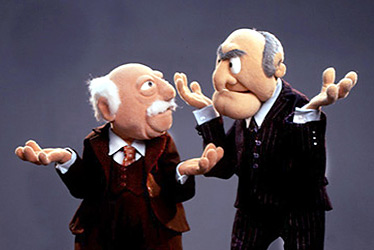
Goldman Sachs is in the news again, this time because a now former executive by the name of Greg Smith wrote a scathing resignation letter published in the New York Times titled Why I Am Leaving Goldman Sachs. In his article, Mr. Smith (who no doubt will be going to Washington when Congress calls for another investigation), accuses his former employer of putting its own interests ahead of its clients'. That may come as a shock to some people, but I would bet that most clients suspected as much anyway.
Mr. Smith says that Goldman's stock in trade for 143 years has been trust. However, he says that today a new culture has taken over, one which stresses "ripping eyeballs out" and "getting paid." Perhaps most interesting was Mr. Smith's claim that during the past 12 months he heard five different directors refer to their clients as "muppets."
Anyone familiar with the real Muppets would know that Misters Statler and Waldorf (pictured above) are the only ones who are wealthy enough to be Goldman clients. Interestingly (and this is no joke), Goldman Sachs has actually arranged financing deals for movie studios trying to raise money from hedge funds and private equity firms. I could find no evidence, however, that Goldman was involved in any of the Muppet movie deals.
In all seriousness, this is just another incident that tarnishes the reputation of Warren Buffett's favorite investment bank. Buffett, who has long been critical of investment bankers, has praised Goldman Sachs on a number of occasions. Berkshire Hathaway still holds a sizable financial interest in Goldman in the form of warrants, an investment that came about during the financial crisis when Buffett was approached by a former Goldman banker named Byron Trott.
One has to wonder what purpose Mr. Smith's public letter of resignation serves. He must have been very angry or fed up to do what he did. It certainly was one of the greatest displays of publicly burning ones bridges. His actions make it all but certain that no other bank will hire him. Yet Mr. Smith is probably wealthy enough to live comfortably for the rest of his life without having to work. I have no doubt, however, that a number of investment firms would be happy to have him on their staff. Yet criticizing Goldman so publicly for unethical behavior will also bring a certain degree of scrutiny on how exactly Mr. Smith has been earning his living over the past 12 years. Because he must know this, he must also be quite confident that he can withstand the scrutiny.
Tweet
Tuesday, March 06, 2012
Earnings Guidance Revisted
Earnings guidance is one of the more controversial management practices. It is something I feel strongly about. I even devoted a whole chapter to defending this practice in my 2008 book, "Even Buffett Isn't Perfect." Those who would like to see an end to guidance are basically arguing that investors are better off having less information. In a day and age when regulators are trying to increase transparency, this makes no sense.
It was wonderful to see the recent Wall Street Journal article written by Professor Baruch Lev of New York University defending guidance. It reminded me of the excellent interview I had with Professor Lev several years ago when he was a guest on the MoneyMasters video program I used to host at Forbes. Click here to watch Professor Lev's excellent defense of earnings guidance.
Tweet
It was wonderful to see the recent Wall Street Journal article written by Professor Baruch Lev of New York University defending guidance. It reminded me of the excellent interview I had with Professor Lev several years ago when he was a guest on the MoneyMasters video program I used to host at Forbes. Click here to watch Professor Lev's excellent defense of earnings guidance.
Tweet
Saturday, March 03, 2012
Stocks Ignore Economic Woes as Apple Drives the Indexes
The following commentary is derived from a Special Report distributed to subscribers of the Forbes Special Situation Survey on March 2.
So far, 2012 is turning out to be a great year for stocks. Through Friday, March 2, the NASDAQ Composite Index was up 14.2% year-to-date and the S&P 500 was up 8.9%. Of course, both indexes benefit greatly from their inclusion of Apple Inc., which is up 34.6% year-to-date. Apple, which has a market capitalization of more than $500 billion, is about one-fourth larger than Exxon Mobil, the second largest stock in the S&P 500. Because both the NASDAQ Composite and the S&P 500 are cap-weighted, they got a big boost from Apple's outstanding performance. On the other hand, the Dow Jones Industrial Average, which does not include Apple, is up just 6.2% year-to-date. This demonstrates just how influential Apple has been to the other two indexes.
For the most part, the corporate sector of the economy is doing well. Companies have benefited greatly from low interest rates and years of cost-cutting. Profits and balance sheets are strong. Many companies are using cash to increase dividends, repurchase shares, and pay down debt (or at least refinance existing debt with cheaper debt). Yet three critical legs of the economy remain troubled.
Employment – On the surface, there appear to be significant improvements in the employment market. The unemployment rate, which peaked at 10% in October 2009, has gradually declined to 8.3%. Weekly initial jobless claims improved from 659,000 in March 2009 to 351,000 for the week ending February 25, 2012. Nonfarm payrolls increased by 243,000 in January, marking the 16th consecutive month that the economy added jobs. There is no question that these trends are good. They certainly indicate that the jobs market is moving in the right direction. However, the improvement in the unemployment rate is largely an aberration because discouraged workers, who are many, are not counted. Furthermore, initial jobless claims are still higher than they should be in a recovery, and job creation is still much too anemic. Take a look at the employment participation rate to see just how troubled the jobs market remains. This figure is calculated by dividing the civilian labor force by the civilian non-institutional population. This critical measure, which hovered above 66% before the financial crisis of 2008, is now down to just 63.7%. In other words, a smaller proportion of the population is taking part in the labor force. If you think there isn't much difference between 66% and 63.7%, you will probably be shocked to learn that had the participation rate remained at 66%, the unemployment rate today would actually be 11.8% instead of 8.3%. As bad as it is, the unemployment rate looks better simply because fewer people are participating in the jobs market. Also, don't forget that if the jobs market truly strengthens, the unemployment rate should initially rise as more people begin to look for work.
Housing – Warren Buffett argues that the housing market is near bottom. He says that over the long term, the number of housing units must rise in line with the number of households. Today, household formation is outpacing the increase in housing units. That doesn't help the housing market in the short term because there is an oversupply of homes. In the long term, however, more houses will have to be built. Furthermore, because interest rates are low and housing prices are so depressed, the cost of buying a home looks extremely attractive compared to the cost of renting. Buffett is right that the housing market will eventually improve. Of course, the critical question is when? Unfortunately, the latest S&P/Case-Shiller numbers show that we aren't there yet. Housing prices are still falling. In fact, they are almost 35% below the 2006 peak. On average, homes today are worth what they were back in early 2003. Many people who purchased a house after that date are underwater.
Energy – According to the AAA Daily Fuel Gauge Report, the national average price of regular gasoline has reached $3.74 per gallon. In some parts of the country, it is well above $4.00 per gallon. Just one month ago, the national average price was $3.45 per gallon. This 8.4% increase in a month is largely due to the rise in crude oil prices. The oil market has been particularly sensitive to rumors. For example, any talk that Israel is about to attack Iran in order to destroy that nation’s nuclear capabilities causes prices to rally. A recent rumor that a pipeline in Saudi Arabia exploded caused another spike in oil prices. Interestingly, that rumor, which turned out to be false, appears to have originated in Iran. That may not be surprising, yet the reaction showed just how nervous oil traders are. Demand for gasoline, which has been depressed since the start of the financial crisis, was starting to pick up. Higher gasoline prices, however, are likely to reduce demand again, which is not a good development for the economy. Higher gasoline prices could also fuel inflation. One energy bright spot is natural gas, which is plentiful, cheap, and not imported. Maybe it's time to start thinking more seriously about alternative sources of energy, such as T. Boone Pickens' idea of converting long-haul trucks to natural gas.
Tweet
So far, 2012 is turning out to be a great year for stocks. Through Friday, March 2, the NASDAQ Composite Index was up 14.2% year-to-date and the S&P 500 was up 8.9%. Of course, both indexes benefit greatly from their inclusion of Apple Inc., which is up 34.6% year-to-date. Apple, which has a market capitalization of more than $500 billion, is about one-fourth larger than Exxon Mobil, the second largest stock in the S&P 500. Because both the NASDAQ Composite and the S&P 500 are cap-weighted, they got a big boost from Apple's outstanding performance. On the other hand, the Dow Jones Industrial Average, which does not include Apple, is up just 6.2% year-to-date. This demonstrates just how influential Apple has been to the other two indexes.
For the most part, the corporate sector of the economy is doing well. Companies have benefited greatly from low interest rates and years of cost-cutting. Profits and balance sheets are strong. Many companies are using cash to increase dividends, repurchase shares, and pay down debt (or at least refinance existing debt with cheaper debt). Yet three critical legs of the economy remain troubled.
Employment – On the surface, there appear to be significant improvements in the employment market. The unemployment rate, which peaked at 10% in October 2009, has gradually declined to 8.3%. Weekly initial jobless claims improved from 659,000 in March 2009 to 351,000 for the week ending February 25, 2012. Nonfarm payrolls increased by 243,000 in January, marking the 16th consecutive month that the economy added jobs. There is no question that these trends are good. They certainly indicate that the jobs market is moving in the right direction. However, the improvement in the unemployment rate is largely an aberration because discouraged workers, who are many, are not counted. Furthermore, initial jobless claims are still higher than they should be in a recovery, and job creation is still much too anemic. Take a look at the employment participation rate to see just how troubled the jobs market remains. This figure is calculated by dividing the civilian labor force by the civilian non-institutional population. This critical measure, which hovered above 66% before the financial crisis of 2008, is now down to just 63.7%. In other words, a smaller proportion of the population is taking part in the labor force. If you think there isn't much difference between 66% and 63.7%, you will probably be shocked to learn that had the participation rate remained at 66%, the unemployment rate today would actually be 11.8% instead of 8.3%. As bad as it is, the unemployment rate looks better simply because fewer people are participating in the jobs market. Also, don't forget that if the jobs market truly strengthens, the unemployment rate should initially rise as more people begin to look for work.
Housing – Warren Buffett argues that the housing market is near bottom. He says that over the long term, the number of housing units must rise in line with the number of households. Today, household formation is outpacing the increase in housing units. That doesn't help the housing market in the short term because there is an oversupply of homes. In the long term, however, more houses will have to be built. Furthermore, because interest rates are low and housing prices are so depressed, the cost of buying a home looks extremely attractive compared to the cost of renting. Buffett is right that the housing market will eventually improve. Of course, the critical question is when? Unfortunately, the latest S&P/Case-Shiller numbers show that we aren't there yet. Housing prices are still falling. In fact, they are almost 35% below the 2006 peak. On average, homes today are worth what they were back in early 2003. Many people who purchased a house after that date are underwater.
Energy – According to the AAA Daily Fuel Gauge Report, the national average price of regular gasoline has reached $3.74 per gallon. In some parts of the country, it is well above $4.00 per gallon. Just one month ago, the national average price was $3.45 per gallon. This 8.4% increase in a month is largely due to the rise in crude oil prices. The oil market has been particularly sensitive to rumors. For example, any talk that Israel is about to attack Iran in order to destroy that nation’s nuclear capabilities causes prices to rally. A recent rumor that a pipeline in Saudi Arabia exploded caused another spike in oil prices. Interestingly, that rumor, which turned out to be false, appears to have originated in Iran. That may not be surprising, yet the reaction showed just how nervous oil traders are. Demand for gasoline, which has been depressed since the start of the financial crisis, was starting to pick up. Higher gasoline prices, however, are likely to reduce demand again, which is not a good development for the economy. Higher gasoline prices could also fuel inflation. One energy bright spot is natural gas, which is plentiful, cheap, and not imported. Maybe it's time to start thinking more seriously about alternative sources of energy, such as T. Boone Pickens' idea of converting long-haul trucks to natural gas.
Tweet
Subscribe to:
Posts (Atom)